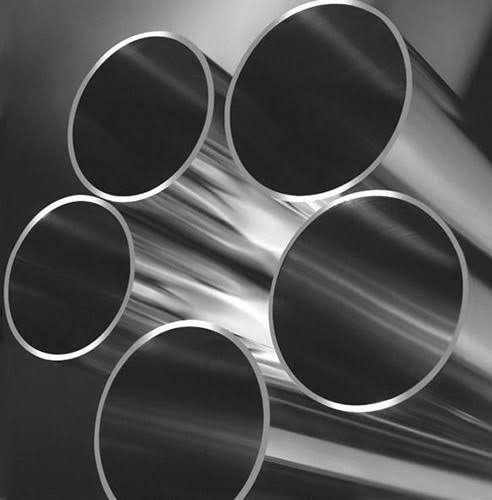
Buyers sourcing industrial-grade stainless for decorative tubing, appliance exteriors or light structural work often face the same trade-off: keep costs down without inviting early corrosion or forming problems. Grades 201 and 430 dominate this entry-level segment in China and many export markets because both avoid the higher nickel bill of 304 while still delivering a usable stainless surface. Their metallurgy, however, points them toward different jobs.
China's 2025 stainless crude steel output reached 40.87 million tonnes, according to the Stainless Steel Branch of the China Iron and Steel Industry Association. Within that total, chromium-manganese (200-series) steel accounted for 11.64 million tonnes and chromium (400-series) steel for 7.58 million tonnes. These volumes reflect the heavy domestic demand for cost-sensitive products such as decorative pipe and white-goods panels.
201: the high-volume decorative-tube workhorse
201 is an austenitic grade that substitutes manganese for a large share of nickel. Typical composition runs 16–18 % chromium, 3.5–5.5 % nickel and 5.5–7.5 % manganese. The resulting combination of good cold formability, higher strength after work hardening and relatively low price has made it the default material for welded decorative tube in Foshan and Wuxi. Mysteel market data from mid-October 2026 show common 201/J2 and J3 decorative tubes trading in the 8 600–10 050 yuan-per-tonne range, well below 304 equivalents.
The grade performs adequately indoors or in dry atmospheres and can be drawn or bent into handrails, furniture frames and light architectural profiles. Its limitations appear quickly in humid or chloride-bearing environments: pitting resistance is modest, and surface rust can develop within a few years if the material is left unprotected outdoors or near coastal sites. Weld discoloration is also more pronounced than with higher-nickel austenitics.

430: the appliance-shell standard
430 is a ferritic, essentially nickel-free grade (≤ 0.75 % Ni) with 16–18 % chromium. Its magnetic behaviour, stable pricing and acceptable resistance to mild indoor corrosion have secured it a leading position in home-appliance outer panels. Industry analyses place 430 at roughly 38 % of the global 400-series revenue share; Chinese appliance makers alone consumed an estimated 420 000 tonnes of 430 sheet in 2024 for refrigerator doors, washing-machine cabinets, range-hood housings and microwave exteriors.
Because it contains almost no nickel, 430 is largely insulated from nickel-price swings and typically sits slightly below 201 on a coil basis. Formability is good for moderate stamping but less suitable for deep drawing or complex tube bending; weldability is also more restricted. The grade's magnetism is an asset when induction compatibility or magnetic accessory attachment is required.
Matching grade to application and avoiding common pitfalls
For decorative tube and formed furniture components where moderate strength and cold workability matter most, 201 remains the volume leader. For flat or lightly formed appliance skins and indoor trim that benefit from magnetism and nickel-free economics, 430 is usually the more rational choice. Neither grade should be specified for outdoor marine exposure, food-contact surfaces that see prolonged wet cleaning, or any service involving chlorides.
Procurement risks are straightforward. Some suppliers label lower-manganese or higher-carbon material as "201" to cut cost; others deliver 430 with inadequate surface finish that shows orange-peel after forming. Request mill test certificates that list actual nickel, manganese and chromium, verify zinc-free surface cleanliness for appliance panels, and confirm dimensional tolerances with laser or micrometer checks on incoming coils or tubes. Independent third-party sampling of a few coils per shipment remains the most reliable safeguard when buying from new suppliers.
In short, 201 and 430 each occupy a clear, high-volume niche inside China's stainless ecosystem. Selecting the grade that matches the actual environment and fabrication route, rather than chasing the absolute lowest headline price, keeps both initial cost and later maintenance under control. For material selection support or current coil availability, contact our team or request a quote.