

Steel remains essential in curtain wall systems for high-rise façades, enabling longer spans, slender profiles, and reliable resistance to wind, seismic, thermal, and water loads while remaining non-load-bearing. Performance is governed by defined criteria rather than primary structural codes alone. Drawing on comparative assessments such as those published in the Journal of Architectural Engineering (ASCE, 2026), which examined ASTM testing protocols against European, Canadian, and Australian approaches for façade systems, and on material equivalence guidance from sources including the PolyU CNERC professional guide on steel equivalence for Eurocode projects, the practical differences between U.S. and European frameworks become clear in both design philosophy and project delivery.
In the United States, ASTM A36/A36M carbon structural steel (minimum yield 250 MPa) is frequently specified for mullions, reinforcements, and anchors because of its weldability and cost profile. System-level verification relies on empirical testing: ASTM E330 for structural performance under uniform static air-pressure differential (deflection and ultimate strength under design wind), ASTM E331 for water penetration, and ASTM E283 for air leakage. Design of the steel members themselves follows AISC 360 using either Allowable Stress Design or Load and Resistance Factor Design, integrated with the International Building Code for site-specific wind and seismic zones. Mock-up testing is common on larger projects.
European practice centres on EN 13830:2015+A1:2020, the product standard for curtain-walling kits. It sets requirements for weather-tightness, mechanical resistance, safety in use, and energy performance; Annex C explicitly guides the application of Eurocode rules to curtain-wall components. Structural design of steel members uses EN 1993-1-1 (Eurocode 3), typically with S275 or S355 grades (yield 275 MPa and 355 MPa). Limit-state design distinguishes ultimate and serviceability limit states, with wind actions taken from EN 1991-1-4 and common deflection limits around L/175 to L/200 depending on span. CE marking under the Construction Products Regulation requires type testing and factory production control.
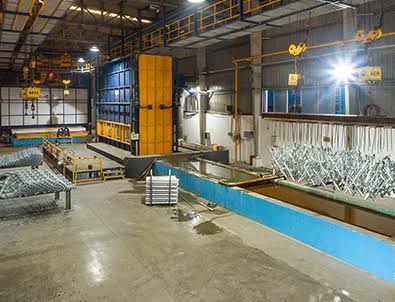
Material correspondence is approximate rather than exact. ASTM A36 is broadly comparable in strength to EN S275; S355 aligns more closely with ASTM A572 Grade 50. The U.S. approach leans toward project-specific empirical testing, while Eurocode 3 emphasises analytical calculation calibrated by partial factors and verified by testing. Both frameworks require durable corrosion protection. Hot-dip galvanizing is routinely specified to ASTM A123 or EN ISO 1461; coating thickness requirements differ slightly by steel thickness and exposure, and equivalence demonstrations are often needed for dual-compliant supply. Thermal bridging and long-term durability receive explicit attention in both systems.
Bidding and tender requirements diverge by market. In the United States and Canada, project specifications typically mandate ASTM/AAMA test reports (E283, E330, E331, sometimes dynamic water testing under AAMA 501) plus AISC calculations and, for taller buildings, NFPA 285 fire-propagation evidence. European and UK tenders require CE or UKCA marking to EN 13830, Eurocode calculations, and factory production control documentation. In the Gulf (UAE, Saudi Arabia), authorities such as Dubai Municipality or Saudi Building Code often accept hybrid packages-ASTM or EN test data plus local wind-load calculations (frequently ASCE 7 or EN 1991-1-4) and civil-defence fire approvals. Chinese domestic projects reference GB standards and, for precision steel-profile glass curtain walls, association specifications such as T/CECS 1482-2023, while export-oriented fabricators must demonstrate ASTM or EN equivalence. Middle-East and Southeast-Asian tenders increasingly demand third-party lab reports, material traceability, and, for coastal exposure, higher zinc-coating masses.
Compliance selection therefore turns on three practical steps. First, map the governing jurisdiction early and identify the primary test suite (ASTM series or EN 13830 suite) rather than assuming interchangeability. Second, select steel grades and coating systems that satisfy both the mechanical requirements of AISC/Eurocode 3 and the durability demands of the exposure class; continuous galvanized coil or sheet meeting ASTM A653 or EN 10346, subsequently fabricated and, where needed, batch-galvanized to A123/ISO 1461, provides a verifiable route. Third, obtain project-specific mock-up or type-test data and maintain full mill certificates and coating-thickness records. Dual-compliance packages that demonstrate equivalence between ASTM and EN routes reduce risk on international projects.
For curtain-wall fabricators and contractors seeking steel that meets these performance and documentation requirements, high-quality hot-dip galvanized steel coil and galvanized steel sheet formulated for building façades offer consistent zinc coatings, dimensional accuracy, and the necessary mill documentation. Contact the technical team at sino-galvanized.com to discuss grade, coating mass, and certification packages tailored to ASTM, Eurocode, or hybrid tender specifications.


