

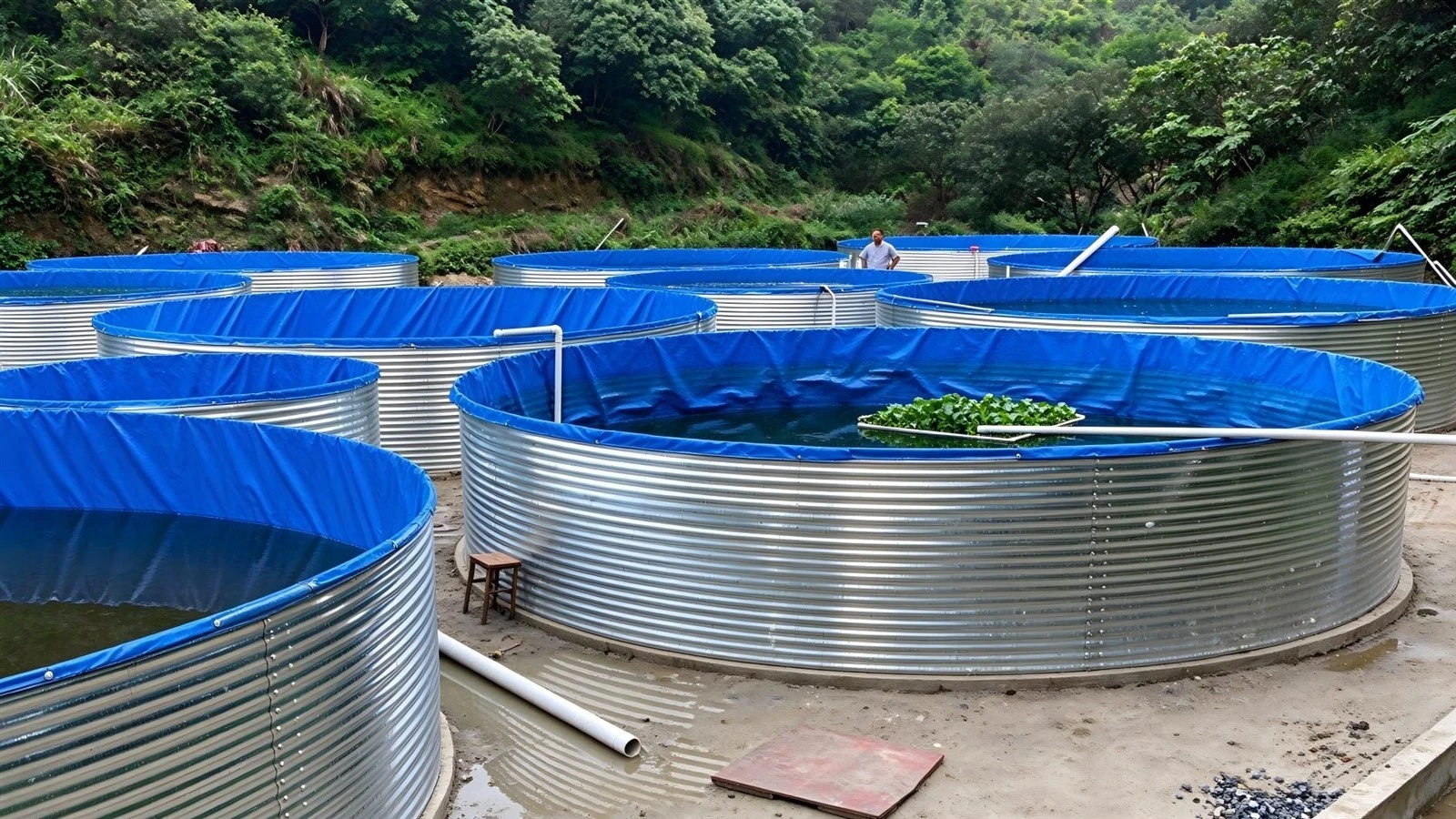
A few years ago, almost every corrugated steel tank we shipped from our factory went to water storage. Then fish farmers in Africa and Southeast Asia started asking whether the same panels could hold fish. Today, the aquaculture version outsells the plain water tank in more than a few markets.
This guide covers what a galvanized steel fish pond is, how the material behaves in water, how it compares with earthen and concrete ponds, and how to size one without guessing. It's the conversation we end up having most often with buyers, written down. If you're already past the decision stage, our companion guide walks through installation and maintenance step by step.
Why Farmers Are Moving Off the Dirt


Earthen ponds are cheap to dig, and for many small farms that's where the advantages end. Water seeps through the banks, sludge builds up faster than most people can remove it, and a pond that leaks is a pond that can't hold the temperature or oxygen level you're trying to maintain. Concrete fixes the leaking, but it brings a different problem: it's a permanent building. You pour it, wait for it to cure, and if the site or the market changes, you walk away from it.
A galvanized steel pond sits between those two. It's an above-ground structure you assemble in days on a level site, and you can take it apart and move it if you need to. For farmers who are renting land, expanding step by step, or moving into intensive production without a big construction budget, that flexibility is often the deciding factor.
What a Galvanized Steel Fish Pond Actually Is


A galvanized steel fish pond is a round or rectangular tank made of corrugated galvanized steel panels bolted together, with a food-grade PVC or HDPE liner on the inside. The steel carries the structure; the liner holds the water. That division of work matters, because it's the same reason these tanks ship flat in a container and go up with two people and a socket wrench.
The panels start as steel coils. In our plant, the coil is cold-rolled, hot-dip galvanized, then roll-formed into corrugated sheets and cut to length with pre-punched bolt holes. The corrugation isn't decoration. It stiffens the sheet so a panel between 1.0 and 2.0 mm thick can hold back tens of thousands of liters of water. The same material family is used for grain silos and municipal water tanks, which tells you something about its track record.
Don't underrate the liner. It's the part that actually touches the water, so it has to be food-grade, UV-stable and thick enough to survive years of cleaning and fish traffic. Most tanks use PVC or HDPE, welded at the seams. When a supplier talks about tank quality, listen for what they say about the liner, not just the steel.
The Material Story: Why Galvanized Steel Works
Galvanizing means coating the steel with zinc. The zinc does two jobs. It forms a barrier between the steel and the weather, and when the coating gets scratched down to the bare steel, the zinc keeps corroding in preference to the steel. That's why a small scratch doesn't turn into a running rust line overnight.
On a fish pond, the liner protects the inside surface, so the galvanized side mainly faces the outdoors. What matters when you buy panels is the coating weight. Common commercial grades run around Z275 under EN 10346 or GB/T 2518, which means roughly 275 g/m² of zinc across both faces, about 20 µm per face. The ASTM equivalent, G90 under ASTM A653/A653M, is a similar coating mass. Heavier coatings cost a bit more and earn their keep near the coast or in high-humidity areas.
A supplier should be able to tell you the exact coating grade on your panels and show you the mill test certificate. If they can't, that's a red flag worth taking seriously. You're buying the zinc as much as the steel.
The panel-and-bolt design itself isn't new. The same construction principle, factory-coated bolted steel panels, has been standardized for water storage tanks for decades under ANSI/AWWA D103. Fish pond panels are a lighter, liner-based cousin of that technology. When a supplier builds to a recognized standard, it usually shows in the details: consistent panel dimensions, proper bolt patterns and a liner that actually fits.
Zinc does wear down over time, faster in coastal salt air and in acidic conditions. That's normal, and it's why coating grade matters. The liner protects the water side from the zinc, the zinc protects the steel from the weather, and the two together are what give the tank its service life.
Galvanized Steel vs. Earthen vs. Concrete: An Honest Comparison
|
Consideration |
Earthen pond |
Concrete pond |
Galvanized steel pond |
|
Initial cost |
Lowest to dig |
High, plus labor and curing |
Mid-range; no wet trades |
|
Time to first use |
Weeks to settle |
Weeks to months |
Days after delivery |
|
Water tightness |
Depends on the soil |
Good if built well |
Reliable while the liner is intact |
|
Relocation |
Not practical |
Not practical |
Bolts apart and moves |
|
Sludge removal |
Needs machinery |
Easier, still labor-heavy |
Drain, rinse, done |
|
Stocking density |
Limited by water quality |
Moderate to high |
High with aeration |
|
Lifespan |
Varies with soil |
Long if it doesn't crack |
Steel structure lasts; liner is replaceable |
Read that table as a trade-off, not a scoreboard. If you have good clay soil, cheap land and no plans to move, an earthen pond can still be the right call. If you're building a permanent facility and concrete labor is affordable, that choice is defensible too. Steel ponds win when time, flexibility and water control matter more than the lowest possible first cost.
Where Galvanized Fish Ponds Perform Best
These tanks are overwhelmingly used with freshwater species, and tilapia is the clear leader. The round shape is a natural fit for RAS and biofloc systems, where water keeps moving and solid waste settles toward the center for easy removal. Catfish, carp and ornamental fish are common too, and some hatcheries use smaller units for nursery stages.
Shrimp farmers sometimes use them for low-salinity culture or nursery work, but full seawater operation needs a different conversation. Salt water is harder on fittings, seals and liners. If you're thinking about seawater, raise it with the supplier before you order, not after.
The economics make sense for a particular kind of farming. If you're doing low-density, extensive culture in a warm climate, a cheap earthen pond is hard to beat. Steel tanks pay off when water quality is the constraint: higher density, better feed conversion, faster growth cycles. That's why you see them in biofloc and RAS setups, where the tank is part of the production system, not just a container.
How to Size a Galvanized Fish Pond
You don't need a spreadsheet to size a round pond. Volume in liters is π × radius² × depth, with the radius and depth in meters, times 1,000. A common commercial size works out like this: a tank 6 m in diameter and 1.45 m deep holds about 41,000 liters. That's a unit you'll see quoted by several manufacturers, and the math checks out.
Depth is a separate decision. Most tilapia systems run a working water depth of roughly 1.2 to 1.5 m. Deeper doesn't automatically mean better, because you still need to move oxygen to the bottom and remove waste from it.

Stocking density is where beginners usually misplan. With good aeration, tilapia densities in tanks can exceed 60 kg/m³, and commercial systems running supplemental oxygen routinely plan for 90 to 120 kg/m³. Without aeration, plan for far less. Those are planning figures, not promises, and the real limit is your oxygen supply and waste removal on the hottest day of the year. Work backwards from the production you want, then pick the tank size.
The practical way to choose: decide the harvest size you're aiming for, convert it to water volume using a stocking density you can actually support, then add margin. If that sounds backwards, it's the correct direction. Tanks are chosen to fit production targets, not the other way around.
Cost and Lifespan: What You Should Budget For
Price per liter drops as tanks get bigger, because the steel area grows more slowly than the volume. A small backyard tank costs more per liter than a 40,000 L unit, which is why commercial buyers rarely start small.
On lifespan, separate the two components. A galvanized steel structure outdoors, with a liner protecting the water side, typically serves for many years. The liner is the component that wears, and it should be inspected and replaced according to the manufacturer's schedule. Coastal salt air, acidic water and physical damage shorten both, so site and habits matter. Ask the supplier to put the expected service life in writing, then build your maintenance around it.
Remember the hidden costs when you compare quotes. Transport to your site, the base preparation, and the liner replacement down the road all count. A slightly more expensive tank with a heavier coating and a better liner can end up cheaper over ten years than a bargain unit with thin materials. Compare the whole system, not the invoice.
Final Word: Is It Right for Your Farm?
If you're renting land, scaling up gradually, or starting intensive freshwater culture and you want water tightness without a construction project, a galvanized steel fish pond deserves a serious look. If you own the land, plan to stay, and concrete labor is cheap, the old ways still work.
We make the steel panels ourselves and ship them flat worldwide, with custom diameters, depths and liner options. If you're sizing a system, our team can run the numbers with you. Send us the inquiry form with your target species and volume, and we'll take it from there.


