How Condensation Forms Inside Containers
Steel container walls heat and cool rapidly with the external environment. Daytime solar radiation can push exterior surface temperatures above 60 °C, while nighttime cooling drops them sharply. The American Galvanizers Association (AGA) notes that rain, dew, condensation, and high humidity initiate zinc reactions when adjacent surfaces restrict ventilation. Physically, air's moisture-holding capacity roughly doubles for every 10 °C rise (Clausius-Clapeyron relation). A 40-foot high-cube container sealed at a humid Southeast Asian port (approximately 30 °C and 80 % relative humidity) can hold about 24 g of water vapor per cubic meter. When nighttime or higher-latitude temperatures fall toward 10 °C, capacity drops to roughly 9.4 g/m³. The excess-more than one liter of liquid water across a typical 76 m³ volume-condenses on the coldest surfaces: the container ceiling, walls, and the relatively cooler steel coil itself. Diurnal cycles of 15–20 °C are common even on a single voyage, producing multiple wet-dry events. Moisture also enters from loading air, wooden dunnage, or packaging that has absorbed ambient humidity.
Why Condensation Accelerates White Rust Between Coil Layers
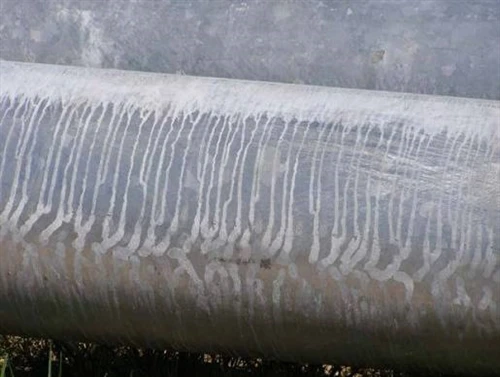
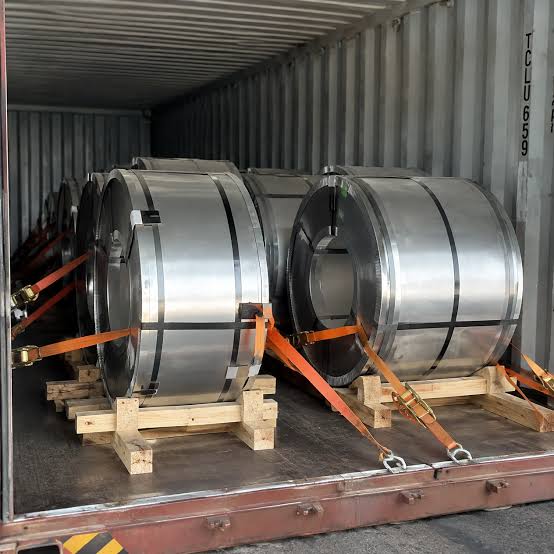
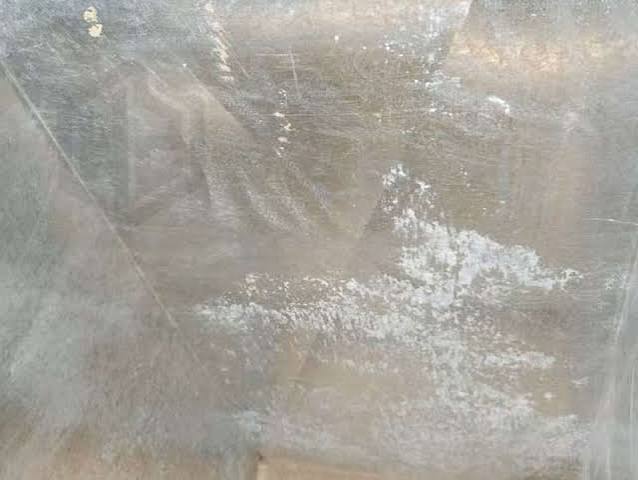
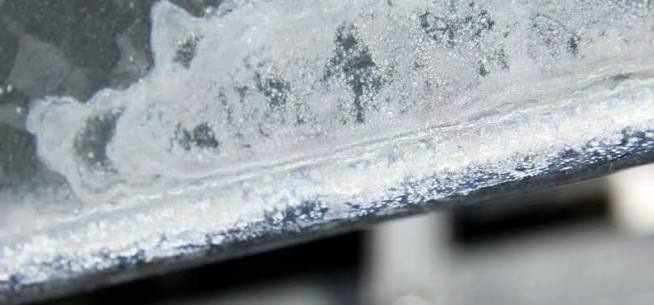
Once liquid water reaches the coil, capillary action draws it into the narrow gaps between wraps. Stacking pressure keeps the layers in close contact, severely limiting oxygen and carbon dioxide exchange. Under these relatively anaerobic conditions the normal protective zinc-carbonate patina cannot form. Instead, zinc reacts with water to produce bulky, poorly adherent zinc hydroxide and zinc oxide-the white or light-gray powder recognized as white rust. The AGA describes this as wet storage stain that develops on newly galvanized material when moisture is trapped between nested or stacked surfaces. Light deposits are frequently cosmetic and do not reduce expected coating life provided remaining zinc thickness still meets the minimum specified in ASTM A123; heavier build-up can consume zinc locally and warrants measurement. Because coils present large, flat contact areas with almost no free airflow, even modest amounts of condensation can sustain the reaction for weeks of transit.
Routes and Seasons With Elevated Risk
Risk rises on routes that cross large climate gradients or load under high ambient humidity. Asia–Europe services via the Suez Canal and Red Sea are especially exposed: containers may experience intense heating in the Red Sea followed by rapid cooling in the Mediterranean and North Atlantic. Research estimating condensation probability on Far East Asia–Europe voyages has reported maxima near 50 % under winter conditions, driven by latitude, sea-area, and seasonal weather changes. Southeast Asian monsoon periods (roughly May–November) load containers with air that is already near saturation; subsequent passage into cooler waters or higher latitudes then forces condensation. Trans-Pacific sailings that move from warm southern ports into colder northern latitudes produce similar repeated dew-point crossings. Geographic background therefore matters: origin humidity at loading ports in southern China, Vietnam, or Indonesia combined with destination temperature drops amplifies the mechanism.
Basic Moisture-Control Measures During Transit
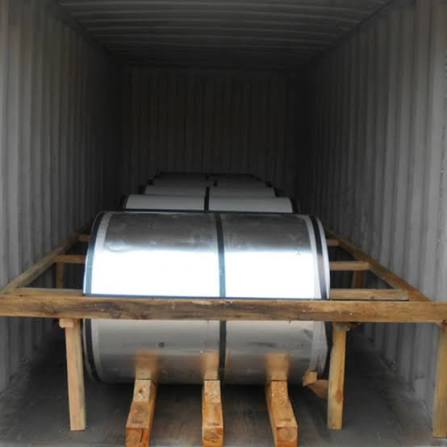
Practical steps focus on reducing available water and allowing residual moisture to escape. Load only dry coils and packaging; residual quench water or rain exposure should be eliminated before wrapping. Place calcium-chloride or silica-gel desiccants inside the container (typical guidance ranges from 1–2 kg per 20-foot unit, scaled to volume and expected voyage length) to keep internal relative humidity below levels that favor sustained condensation. Vapor-phase corrosion-inhibitor (VCI) paper in contact with the zinc surface provides an additional protective layer. Prefer multi-layer packaging that includes a moisture barrier yet avoids fully sealed plastic films that can trap condensation once it forms. Elevate coils on wooden dunnage to prevent floor contact and improve limited air movement. Pre-loading inspection of container seals and floors further limits external water ingress. These measures do not eliminate all risk but measurably lower the probability of free water reaching the inter-wrap spaces.
| Transport Factor | Impact on White Rust | Risk Level | Intervenability |
|---|---|---|---|
| Container condensation | Directly supplies moisture | High | Medium |
| Tight coil packaging | Impedes moisture escape | Medium-High | High |
| Route temperature/humidity swings | Intensifies condensation cycles | Medium | Low |
| Moisture-proof packaging & desiccants | Significantly reduces free water | - | High |
Buyers and suppliers evaluating sea-export shipments can use the above relationships when comparing packaging specifications, voyage length, and seasonal windows. For detailed packaging and logistics recommendations on protecting galvanized coils, consult the packaging logistics guidance page or contact us.