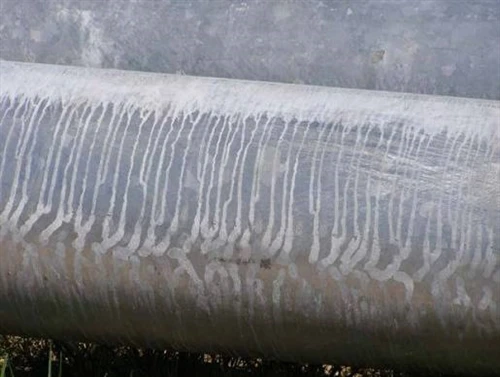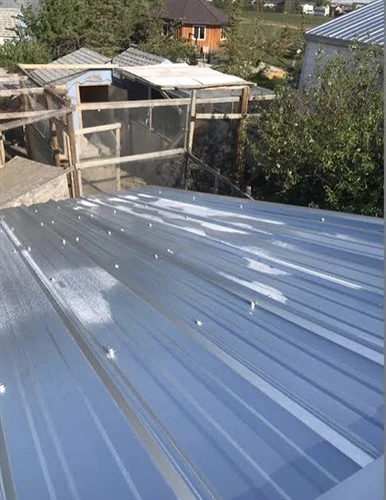

White rust claims on galvanized coil rarely begin in your warehouse. In the ones we have handled, the moisture was already inside the pack when the container was sealed, and nothing at destination could have reversed it.
We produce and trade hot-dip galvanized coil and pack it on our own lines. What follows is the specification we work to, and the parts worth writing into a purchase order.
Where the water comes from
Three sources account for most of it.
A coil wrapped while still warm carries its own problem: the steel cools inside the film, the air around it cools faster, and the moisture that air held condenses onto the zinc. Damp paper and board, and the air sealed in on a wet afternoon, add the rest.
None of it shows at loading. The film looks tight, the coil passes inspection. The corrosion appears two to four weeks later, mid ocean, when nothing can be done.
What we apply, and in what order
Our sequence is fixed, and it is fixed for reasons that are easy to lose when a packing line is busy.
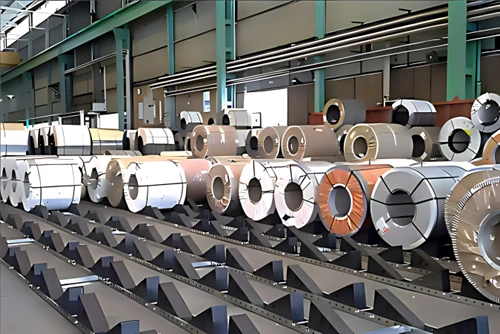
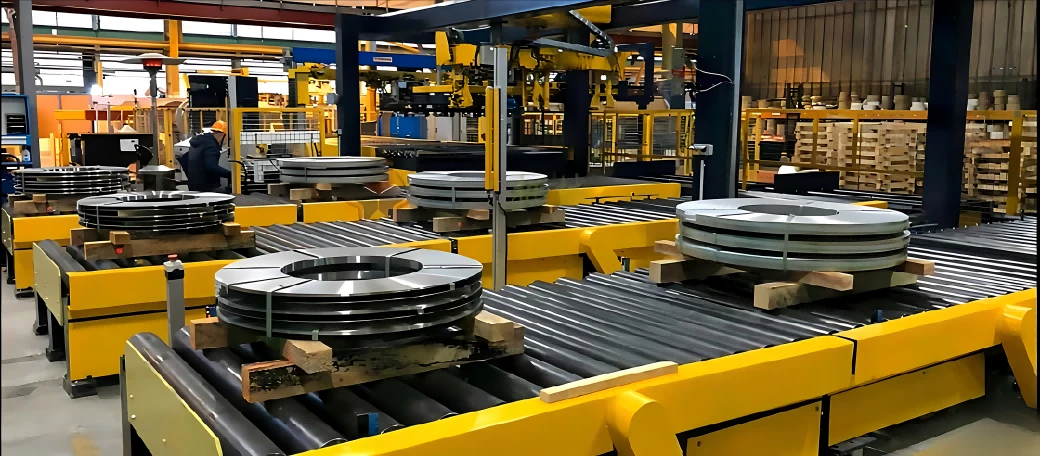
The coil stands until its surface is close to ambient temperature, then it is oiled, edges as carefully as the strip face. Desiccant is fixed at the eye and along the body, then the inner paper, the film, the edge rings, the strapping and the marks.
Two steps are often done in the wrong order. Desiccant outside the film absorbs container air and leaves the coil untouched. Edge protection fitted after wrapping does nothing about the film the coil edge has already cut.
Oil and passivation are one decision
Whether a coil needs oil depends on what was done to the surface before it was wound.
A chromium-free passivation leaves a thin conversion layer that slows white rust on its own; oil on top adds a physical barrier and buys time. Coil with neither passivation nor oil has little beyond the film between it and condensation.
This matters to buyers who paint, weld or anneal. Oil that protects in transit may have to come off before your first process step, so ask which treatment and which oil you receive, and check your cleaning line handles them. A specification that skips the question creates a production problem six weeks after delivery.
Desiccant is a calculation, not a habit
Quantity should follow the cubic metres of air enclosed by the barrier, the mass of paper and board inside it, and the days in transit. A single small bag taped to the eye of a ten tonne coil looks reassuring and changes very little.
On long routes we raise the fill and specify where each unit sits. A bag that slides to one end during handling protects only that end.
Ocean freight is where packing is tested
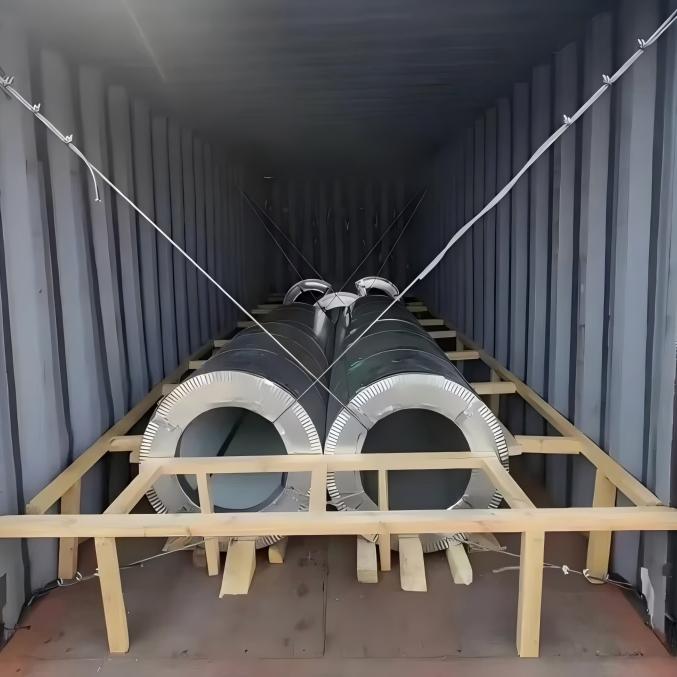
Container rain comes first. A steel box crossing climate zones cools at night and warms by day; water collects on the ceiling and walls, then falls onto the cargo. Container desiccant, wall liners and stowage away from the doors cut the exposure, and quantity should follow container volume and voyage length, not coil count.
Time compounds the problem. Thirty to forty five days gives trapped moisture far more opportunity than a three day road leg, and a pack that survives a short trial can still fail at sea. A domestic shipment is no test of export packing.
Loading temperature is the third, and the one most often missed. A warm coil in a cool container condenses within hours, before the vessel sails. We let coils equalise before final wrapping and check that paper, boards and pallets are dry.
Mixed cargo matters too. Timber, bagged goods and wet pallets raise humidity in the whole container, so keep galvanized coil away from them or add desiccant. Export pallets and dunnage also need ISPM 15 treatment, a customs point rather than a corrosion one, but part of delivering the coil as bought.
Marking belongs here as well. Coil number, grade, size, weights, packing date and ISO 780 pictograms go outside the wrap in ink that survives rain. Eye orientation should be stated: a coil stored eye to sky collects water in the eye, one stored eye to wall does not.
Where galvanized coil packaging tends to fail
Table 1. Packing measures, what each one does, and the exposure left when one is missing.
|
Packing measure |
What it does |
Sea freight |
If it is missing |
|
Moisture barrier |
Keeps external water out |
Essential |
Condensation reaches the surface |
|
Rust-preventive oil |
Temporary surface barrier |
Recommended |
White rust starts sooner |
|
Desiccant |
Absorbs residual internal moisture |
Recommended |
Humidity stays high inside the wrap |
|
Edge protection |
Guards coil ends and slit edges |
Recommended |
Water enters at the ends |
|
Handling marks |
Correct lifting and storage |
Essential |
Coil stored or slung incorrectly |
A table does not replace a specification, and a correct wrap torn during loading protects nothing. Supervision at loading is part of the measure.
Supplier packaging requirements worth putting in writing
Packing terms are easier to enforce before the order than after the claim, and general wording such as export packing or seaworthy packing gives both sides room to disagree later.
Annex a packing specification to the contract: drawings, material grades, film thickness, oil type and quantity, desiccant per coil and per container, edge protection, marking layout. Where a buyer has no specification of their own, we issue our standard export pack drawing with the order confirmation and pack to it. Photographs at packing and at loading travel with the shipping documents, giving you a baseline for what arrives.
Define the claim procedure at the same time. Agree how soon the coil will be unpacked after arrival, who may be present, and what evidence is kept. White rust found on the second day, desiccant saturated and condensation still on the film, is easy to attribute. White rust found after the pack has stood open for a month in a humid yard is not.
Then allocate responsibility by cause. A pack that missed the specification, condensation in transit and open storage at destination are separate failures with separate consequences. A supplier who packed to standard should not absorb a claim from storage at destination, and a buyer should not absorb a pack that never met the standard. EN 10346 and ASTM A653 define coating mass and surface condition at the mill; neither defines how a coil should look after six weeks at sea, which is why the contract has to.
Checking a delivery
Inspect the pack before opening it, and photograph the coil with its number visible.
Torn film, water stains, loose strapping and droplets on the inside of the wrap
Humidity indicator cards, if they were supplied, read before the wrap is disturbed
Desiccant condition, checked and photographed as soon as the wrap is opened
White rust pattern, recorded by position: eye, edge, outer wrap or full surface
Keep the packaging material until the inspection is finished. Saturated desiccant and a damp inner wrap are what turn a complaint into a claim; once they are thrown away, the discussion becomes one opinion against another.
Closing
White rust is prevented by closing the routes water takes to the zinc surface, and most are closed at the packing line, not the port. A sealed barrier, suitable oil, correctly sized desiccant, protected edges and marks that survive rain cover most routes. Long voyages raise the standard without changing the principle.
We publish the packing configurations we recommend, by coating type and route, on our galvanized coil packaging and logistics page. If you are drafting packing terms for a new contract, our technical team will review them against the route you are shipping.