The storage leg decides the outcome
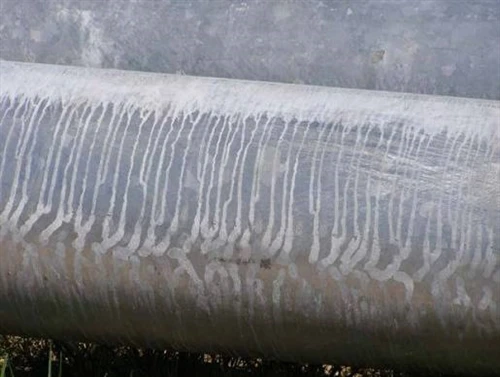
White rust found at the press is usually dated weeks earlier. The coil arrived with a film already forming along the lap edges, the wrap looked sound, and nobody opened it. By the time an operator saw the surface, three or four laps carried a white layer and the outer edge had started to pit.
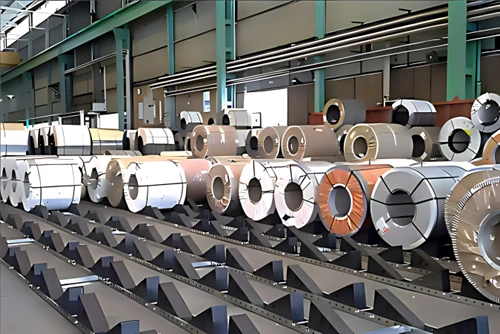
The pattern repeats often enough to describe. The coil that fails is rarely the one that was opened on arrival. It is the one that came in at the end of a shift, went straight into the stack, and stayed sealed until a job called for it. The rest of this note follows the three variables that sit behind that outcome: time to first inspection, coil temperature when the wrap is cut, and the moisture the air in the bay can hold.
What happens between the laps
A wrapped coil is a stack of narrow gaps. Between adjacent laps there is little air exchange and very little carbon dioxide, which is what the zinc needs to build the thin carbonate film that protects it in service. Water present at wrapping, or condensing later, stays where it is. Zinc hydroxide forms first, then a bulkier oxide layer that holds more water and narrows the gap further. The corrosion product takes more space than the zinc it replaced, so the coil begins to close itself.
The water usually arrives through temperature, not weather. A coil loaded on a cold quay and unloaded into a warm, humid warehouse sits below dew point for hours, and condenses on every surface it exposes, including the ones under the wrap.
Receiving
Unloading is the cheapest moment to catch a problem. Inspections after it cost more, and each one recovers less.
Check the wrap before signing. Tears at the eye end, water marks following the spiral of the wrap, and rust stains transferred from wrap to strip all indicate moisture inside. Read the humidity indicator card against its colour scale rather than glancing at it. Then look at the cut edges and the exposed lap ends, which stain first because they present bare zinc and hold water.
Two readings belong on the record: coil surface temperature by infrared thermometer, and air dew point at the dock. The second one catches people out. At 26 °C and 80 percent relative humidity the dew point is 22.3 °C, so a coil that stood outside overnight at 8 °C is fourteen degrees below it and will condense water on any surface opened to the air. If the surface is colder than the dew point, do not open the coil in the yard. Move it under cover and leave the wrap on.
Table 1 Receiving record: minimum fields
|
Field |
Why it is recorded |
Typical entry |
|
Coil and heat number |
Ties the record to the coil and the cast |
A-2214 / H-8842 |
|
Coating and surface |
Sets the baseline for the comparison |
Z275, passivated, oiled |
|
Wrap condition |
First physical evidence of moisture |
Intact, 300 mm tear at eye end |
|
Indicator card |
State of the desiccant at arrival |
Blue, no activation |
|
Surface temperature |
Condensation risk at the moment of inspection |
8 °C |
|
Air temperature and RH |
Inputs for the dew point figure |
26 °C, 80 percent |
|
Dew point |
Threshold the surface is compared against |
22 °C |
|
Action |
What was done, and when |
Held under cover, unpacked after 18 h |
Uncoiling
Uncoil when the job needs it, in conditions you can control, and no earlier. A full coil needs 12 to 24 hours under cover to come to ambient temperature, and a coil that has travelled through a cold night needs the longer end of that range.
Cut the wrap at one end and peel it back only as far as the work requires. Dragging the wrap across the strip marks the surface and wipes condensed water into the laps. Do not open a coil in rain, and avoid it when relative humidity is above about 70 percent.
Breaking the eye is the step most crews skip. The inner laps are where transit moisture collects, and a coil can look sound from outside while staining three laps in. Thread the strip on a dry mandrel, a dry coil car and a dry run-out table. A coil set down on a damp floor takes water along its bottom edge within minutes.
If you consume only part of the coil, protect the remainder before you leave the line. Re-wrap with the original wrap where you still have it, add desiccant if the remainder will sit for days, and return it to dunnage. An open half coil on a rack overnight is how a small stain becomes a rejected coil.
Bay conditions
A dry building is not the same as a dry coil. The bay has to hold a condition, not merely keep the rain out.
Relative humidity 40 to 50 percent. Above 60 percent for long periods, condensation risk climbs even where the air moves.
Coil surface at least 3 °C above dew point, measured at stack level. A hygrometer on the office wall tells you about the office.
Roof and services tight. No leaks, no sprinkler drips, no condensate pipe above a stack, doors shut in wet weather.
Dunnage 100 to 150 mm clear of the floor, never directly on concrete, and 300 mm from external walls, which run colder than the air.
No shared space with wash bays, humid exhaust, unheated neighbour bays, or vehicles parked with wet loads.
Ventilation prevents condensation. It does not dry a wet coil, which is why a fan is not a substitute for an inspection. Sealing a damp coil in plastic makes the position worse: you have built a closed chamber around the moisture.
Direct sun starts its own cycle. A wrapped coil heats through the afternoon and cools after dusk, condensing water inside the wrap every night. Shade costs nothing.
Rotation belongs in the same rule set. First in, first out, with a maximum storage interval for each size. Passivation and oiling extend that interval. Neither removes it, and a year in a humid bay will stain a coil whatever the label says about surface treatment.
Stacking, lifting and the wrap
Stack dry coils on dry coils. Water runs down, and a damp coil at the base keeps every lap above it wet.
Store with the axis vertical where crane and saddles allow, so water runs off the face instead of collecting in the laps. Where horizontal storage is unavoidable, keep the stack low and leave a gap wide enough to inspect. Pressing a stack against a cold wall is the same mistake as stacking wet on dry, only slower.
Use spreader beams or C hooks, and keep chain off the wrap. A torn wrap is an open door, and the next humid night will find it.
Grading a stain
Light and heavy staining call for different decisions, so grade before you act.
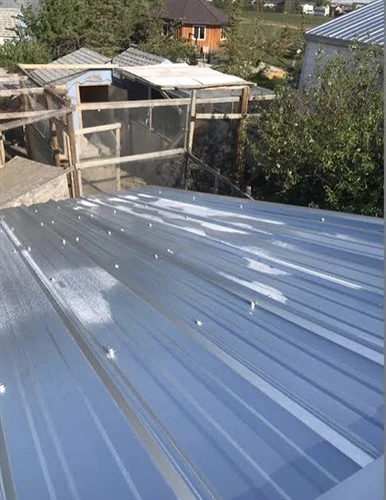
Light staining is a thin white or pale grey film with no pitting. Unwrap, dry the coil at ambient temperature with air moving over it, and keep it out of the stack while damp. If appearance matters for the end use, brush the film off dry. Do not scrub it wet. Book the coil for early consumption.
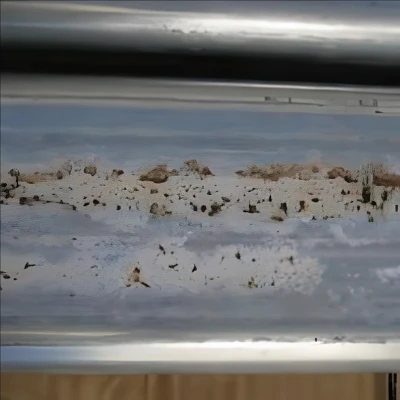
Heavy staining is thicker, darker and pitted where the coating has gone. Segregate it, confirm coating mass by the method in your purchase specification, ASTM A90/A90M or EN 10346, and decide between downgrade, rework and claim. Photograph the lap edges with a rule or a coin in frame, since the scale is what makes a photograph useful six months later, and keep the coil number with the storage record.
Three things not to do: wash white rust with water, acid clean the surface, or oil over a wet coil. Each adds moisture or strips what protection is left.
Practice summary
Table 2 Correct and incorrect practice at each stage
|
Stage |
Do this |
Skip it and |
Result |
|
Unloading |
Read the wrap, the indicator card, the lap edges |
The coil stays sealed for weeks |
Stain grows out of sight |
|
Storage |
Hold 40 to 50 percent RH, above dew point |
It sits in a humid, closed bay |
Corrosion continues |
|
Stacking |
Dry on dry, axis vertical, room to inspect |
A damp coil is compressed under dry stock |
Stain spreads through the laps |
|
After a stain |
Dry it, isolate it, consume it early |
It goes back into the original wrap |
Condition worsens |
|
Inventory |
First in, first out, fixed maximum interval |
It is held until the next project |
Damage found too late |
For the dock and for the rack:
Read the wrap, the indicator card and the lap edges before signing for the load.
Log coil temperature and dew point, then unpack under cover once the gap closes.
Uncoil only what the job needs, break the eye, and check the inner laps.
Re-wrap partial coils with desiccant, and never leave one open overnight.
Hold the bay at 40 to 50 percent RH and rotate stock by age.
Grade any stain on the same shift, dry it, and separate it from clean stock.
None of this is capital spending. It is procedure, and the cost of skipping it lands on the coil.