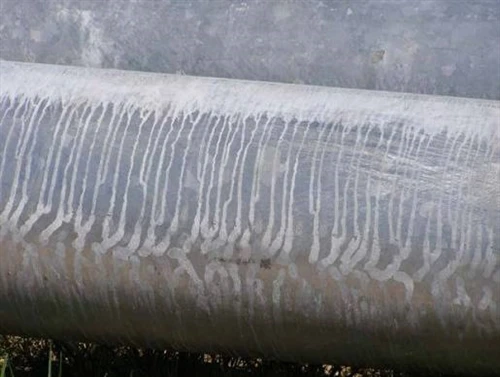
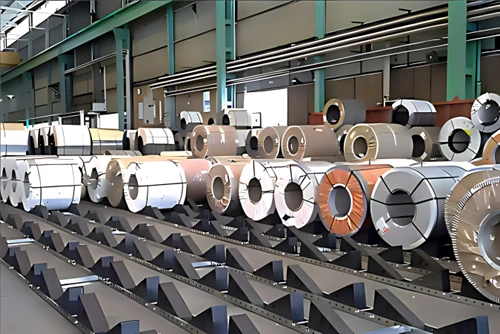
Coil eye red rust observed on arrival is frequently linked to mechanical actions during container loading and ocean transit rather than mill coating quality alone. When wooden dunnage, straps, or blocking contact the coil eye under concentrated force, the zinc layer can be locally breached. Subsequent exposure to container humidity then allows the exposed steel to form iron oxide. Distinguishing these transit effects from factory issues requires attention to loading geometry, force distribution, and environmental conditions inside the box.

Dunnage Placement and Concentrated Loading
Wooden dunnage is used to raise coils clear of the container floor, distribute weight, and prevent rolling. When timbers are placed so they bear directly against the coil eye or its inner edges, the contact area becomes very small relative to coil mass. Commercial coils commonly range from 4 to 26 tonnes. Industry calculations illustrate the resulting stress: a 4-tonne coil resting on a 5 cm support length can generate approximately 8 kg/cm²; heavier coils can exceed 50 kg/cm². Container floors are typically rated for roughly 4–5 tonnes per linear metre when loads are well distributed (per typical carrier guidelines consistent with ISO container design practice). Point loading through poorly positioned dunnage readily exceeds these limits and crushes or abrades the coating at the eye.


According to the IMO CSS Code (Resolution A.714(17), Annex 6 on coiled sheet steel), coils should rest on dunnage laid to spread load, with wedges used only as stoppers and without reliance on nailed blocking alone as the primary restraint. In container practice, longitudinal or athwartships timbers sized to coil weight (for example, 10 × 10 cm sections for lighter coils and larger sections for coils above 8 tonnes) and maintained with a minimum clearance of about 5 cm under the coil help avoid direct eye contact.
Securement Forces and Binding
Straps and lashings restrain movement but can themselves damage the eye when routed or tensioned incorrectly. U.S. Federal Motor Carrier Safety Administration rules (49 CFR 393.120) for metal coils of 2,268 kg or more require, for eye-vertical stowage, diagonal tiedowns that cross the eye and additional top restraints positioned close to the eye. Similar principles apply in ocean containers under the CTU Code framework, which expects arrangements to resist accelerations on the order of 1.0 g longitudinally and 0.8 g transversely. Over-tight bands or straps that bear hard against the unprotected eye create localized crushing or fretting. Edge and eye protectors are therefore standard before final tensioning.


Movement During Transit and Repeated Impacts
Even well-intentioned lashing can loosen under vessel motion. Gaps that allow even modest shifting produce repeated impacts between the coil eye and dunnage, neighboring coils, or container structure. On routes from East Asian mills through equatorial or monsoon-affected waters, temperature swings inside a closed container readily generate condensation ("container rain"). Moisture then reaches any coating breach. The result is progressive conversion of exposed steel to red rust, distinct from the white or gray zinc corrosion products that form on intact but wet galvanized surfaces under restricted airflow.
Protective Practices at the Loading Stage
Effective loading keeps the coil eye free of direct timber or strap contact. Timbers are selected dry and phytosanitary-certified so they do not introduce moisture, sized and spaced to distribute load, and secured against displacement. Eye and edge protectors are applied before strapping. Lashing angles and tension are checked against applicable securing standards, residual voids are filled with appropriate blocking or airbags, and photographic records of dunnage layout and clearances are retained. These steps reduce the probability that localized coating damage will later appear as red rust after a humid voyage.
| Operation | Potential Issue | Effect on Coil Eye | Risk Level |
|---|---|---|---|
| Dunnage placement | Direct contact and compression of the eye | Localized coating damage | High |
| Binding / lashing | Excessive tension or poor routing | Crushing or abrasion | Medium-high |
| Transit movement | Coil displacement and repeated impacts | Progressive fretting of damaged areas | Medium |
| Proper protection | Suitable dunnage, protectors, and controlled fixing | Significant reduction in damage | Low |
Importers examining red rust confined to the coil eye on arrival can use the above patterns-together with loading photographs, dunnage condition, and moisture indicators-to assess whether transit forces and humidity were the dominant factors. For detailed loading recommendations aligned with these practices, refer to the quality and packaging guidance available on this site.