Importers frequently discover red rust concentrated at the coil eye after ocean arrival and immediately question whether the
zinc coating itself was deficient. In most cases the root cause is structural rather than process-related. The inner eye experiences repeated mechanical stress during coiling, lifting, and transit that the flat sheet surfaces do not, making localized coating breaches far more likely. Once the zinc barrier is compromised, ordinary container humidity is enough for iron oxide (red rust) to appear quickly.
Why the Inner Eye Sustains Higher Mechanical Stress
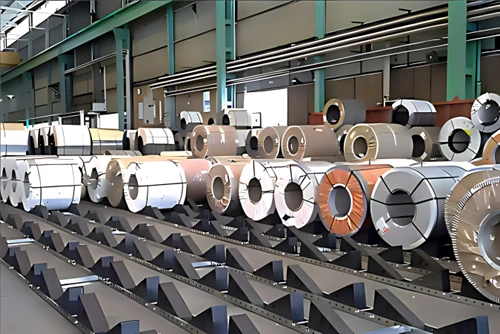
During recoiling the strip is under continuous tension and the innermost wraps bear the highest radial pressure. Subsequent handling with C-hooks, forklift pads, or crane slings contacts the bore edge directly. In horizontal "eye-to-the-side" shipping-the orientation used for most
export coils-the weight of the coil rests on saddles or dunnage. GalvInfo Center technical notes (GalvInfoNote 3.5, International Zinc Association) document that vibration during rail and ocean transit produces fretting or transit abrasion precisely at these load-bearing contact zones. Relative micro-movements of only a few micrometers under load are sufficient to scrape the relatively soft outer zinc layer and, in severe cases, expose the steel substrate. The outer wraps and the mid-width of the strip experience far lower point loading and therefore retain more intact coating.


From Minor Scratch to Visible Red Rust
A coating breach as narrow as a few millimetres removes the barrier protection. In the humid micro-climate inside a sealed container-typical of voyages from East Asian ports to Europe, the Middle East, or the Americas-relative humidity routinely exceeds 70–80 % and diurnal temperature swings drive condensation. Once bare steel is wet, the electrochemical reaction forming iron oxides proceeds rapidly. American Galvanizers Association guidance distinguishes true red rust (corrosion of the steel substrate after coating breach from abrasion or impact) from superficial staining or wet-storage stain on intact zinc. Small damaged areas may still receive limited cathodic protection from adjacent zinc, yet the protection distance is short; any wider or deeper scratch quickly shows red oxide. Because the damage is localized at the eye, the remainder of the coil can retain full
coating thickness and performance.


Position Comparison of Risk
| Position |
Mechanical load & damage risk |
Typical coating integrity |
Red-rust susceptibility |
| Coil-eye inner bore |
High (coiling pressure, hooks, saddles, vibration) |
Frequently compromised |
High |
| Outer wraps |
Medium (strapping, stacking) |
Generally better |
Medium |
| Strip mid-width |
Low |
Best preserved |
Low |
What Coil-Eye Red Rust Does-and Does Not-Indicate
Localized red rust at the eye does not automatically demonstrate that the entire coil failed coating-weight or adhesion specifications. ASTM A123 and related continuous-galvanizing practices evaluate coating quality on the product as produced; post-shipment handling and transit damage fall outside the galvanizer's responsibility once the coil leaves the mill under agreed packing. Importers preparing claims should therefore document the exact location, measure remaining coating thickness on undamaged areas of the same coil, record packaging condition, and note transit duration and climate exposure. Such evidence allows separation of genuine mill defects from transport-induced damage.
For detailed packing standards, moisture-control methods, and a practical claim-evidence checklist, refer to the quality and packaging guidance pages on this site. Clear documentation at arrival remains the most effective way to resolve coil-eye rust claims quickly and accurately.