Most of the shutter enquiries we handle arrive with three numbers attached: strip thickness, slat width, and the RAL code written on the elevation drawing. Zinc mass, coating system and coil weight get settled later, usually in a call between your technical team and ours. That order tells you where the market has moved. In 2026 the finish is decided before the substrate is, because the door or shutter is now part of the façade rather than something bolted on at the end of the job.
The second pressure is running cost. A timber garage door needs recoating every few years, a painted steel panel rusts along the bottom rail where water stands, and neither adds much to how the opening resists wind and water. A venetian blind handles daylight and little else. None of this is new. What changed is that clients now compare it, and that a motor on the shutter puts the whole assembly on the same control system as the lights and the alarm.
The coil behind the slat
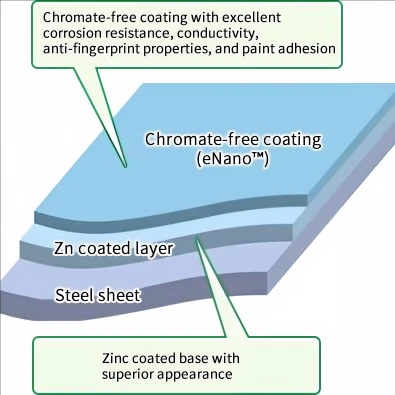
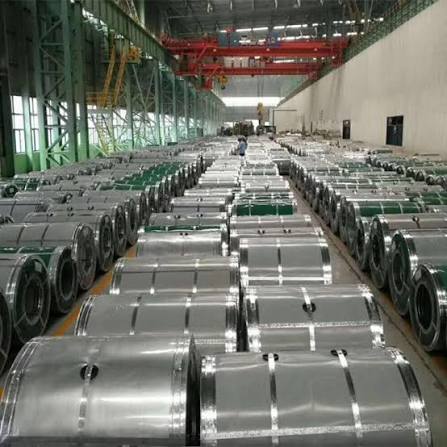
We sell coil, not shutters. The strip we ship is pre-painted hot-dip galvanized, produced to EN 10346, DX51D+Z for most slat forming and drawing grades where the profile turns tight. Zinc mass usually lands between Z120 and Z275; at Z275 you are looking at roughly 20 µm of zinc on each face. We ship at both ends of that range in the same year, sometimes to the same customer for different elevations, and that is normal. What we do not do is guess your corrosion category. Give us the site conditions and we will say what we would put in.
The organic coating is applied on a continuous line to EN 10169: primer, a topcoat of 20 to 25 µm, and a back coat of 5 to 7 µm that protects the inner face and keeps the strip running clean through your forming rolls. Window slats mostly sit at 0.45 to 0.6 mm on 42 to 77 mm profiles. Garage doors go heavier, 0.6 to 0.8 mm, because the curtain spans further and takes more wind. At 0.5 mm the strip weighs about 3.9 kg per square metre before coating, which is where you start when sizing a drive or planning a container.
Coating is an exposure question, not a premium one
Polyester suits temperate inland housing. Silicon-modified polyester holds gloss longer, which is why most warranted elevations end up there. PVDF earns its cost on salt spray, industrial atmosphere and hard ultraviolet, and the service interval pays for it rather than the appearance. EN 10169 sorts these systems into durability classes, so put the class you intend to warrant into the purchase specification, then ask for the test basis behind it.
One point we raise early, because it costs people money later: pre-painted coil and powder coating a finished slat are different processes. Different film build, different cure, different warranty. We have seen a sample approved one way and production run the other, and the argument that follows costs both sides. We cannot test your line or your film thickness. We can certify what left our works.
Energy figures belong to the assembly
A closed curtain cuts solar gain and holds a still air layer against the glass; a sealed box and a clean sill detail are what keep that layer working. Slat type, foam filling, seal geometry and installation tolerance all move the final number. EN 14500 is the test and rating method for thermal and visual comfort, and EN 13659 is the performance standard for the finished shutter, wind resistance included. Both are system tests, run on your product. When a client asks about energy efficient roller shutters 2026 performance figures, we point at the test report, not an estimate. Our datasheet carries no percentage.
What the steel does bring is repeatability. Thickness that holds across a coil means the curtain weighs what the drive was sized for, at both ends of the travel, and the gaps at the guides stay tight. Colour that holds across batches means one window on an elevation does not read lighter than its neighbour. Neither of those shows up in a brochure. Both show up in the second winter.
Smart control runs on tolerance before electronics

Tubular drives, 230 V AC or 24 V DC, radio or bus, app and voice, sun and wind sensors, timers, alarm interlock: the electronics are mature; they are only as reliable as the mechanism they push. Coil-to-coil weight variation eats torque reserve. A curtain heavier than the drive was sized for will trip obstacle detection, drop its end limits or stall on a cold morning. Width variation and camber close the clearance at the guides and make the scrape an owner reports as a motor fault. That is the practical sense in which smart home roller shutter steel is a tolerance product.
Our side of it is unglamorous: thickness to EN 10143, agreed width and camber limits, and one coating line plus one colour reference held for a project series.
The alternatives on the same tender
You are probably quoting aluminium, timber or a post-painted sheet against us, and some of those jobs should go that way. In production terms the four routes sit like this.
Where it goes, and what we need to quote
Houses put PPGI on garage openings, where the door is large, exposed and usually the weakest part of the elevation. Apartments and city houses use residential window roller shutter systems on main windows, full-height glazing and loggias, where the curtain also gives night privacy and a wind barrier upstairs. Retrofit work hangs curtains over frames that stay in place. On the color coated galvanized roller shutter home projects we quote for, colour is usually the first note on the drawing and the last thing the client inspects at handover.
Whole-house schemes are the demanding case. Garage door, window curtains and any façade cassette have to read as one colour, and that means coils matched to a reference rather than to a colour name. We supply pre-painted galvanized and hot-dip galvanized coil, full width or slit, to the thickness, width, zinc mass, coating system and colour you specify. Colour is matched to RAL and to wood grain or matt textures, with an agreed ΔE under D65 and a retained sample per batch. We quote PPGI slat for residential shutters from the trial stage: samples for forming and colour first, mechanical and coating data per heat, advice on roll clearance and edge burr.
What we need back is just as specific: slat profile and developed width, curtain weight per square metre and drive rating, site corrosivity to ISO 12944, the durability class you intend to warrant, annual tonnage by colour. With those lines we can write a coil specification, a tolerance sheet and a coil weight plan. The split of responsibility stays where it belongs. We answer for the coil and for batch consistency. You certify the shutter to EN 13659 and EN 14500. If you are developing PPGI garage door material or a new window profile, send the drawing and the target colour first. Specification, samples and a trial plan come back before anyone talks tonnage.
Table 1: Comparison of slat material routes for residential roller shutters
|
Route |
Energy effect |
Smart compatibility |
Maintenance |
Appearance |
Typical use |
|
High, with foam-filled slat and sealed box |
High |
Very low |
RAL colours, wood grain, matt and textured finishes |
Garage doors, main windows, terraces |
|
|
Aluminium |
Medium to high |
High |
Very low |
Powder-coated, wide colour range |
Light windows, coastal sites |
|
Timber door or traditional shutter |
Medium |
Low |
High, periodic recoating |
Natural, joinery finishes |
Heritage elevations |
|
Post-painted galvanized sheet |
Medium |
Medium |
Medium, repaint at damage |
Limited, applied in-house |
Budget-driven work |