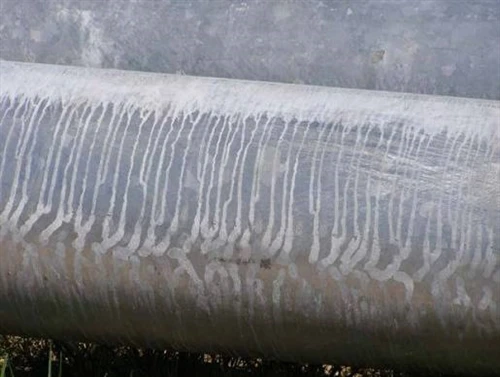
A container is opened at the customer's yard and the bore of the first coil is brown. The question that follows is almost never technical. It is who pays for it.
We produce and ship hot-dip galvanized, 55% aluminium-zinc and colour coated coil, and we have answered more of these claims than we would like. The pattern is consistent. Cases are settled in the first two days after devanning, by what was recorded, not by what was argued three weeks later. A supplier who can show the eye condition at packing, and a buyer who can show the condition at opening, usually reach an agreement quickly. Without those two records the same physical fact turns into a negotiation about goodwill.
The bore is the hardest part of the coil to protect
A coil eye is a 508 mm bore formed by the first laps around the mandrel, and those laps sit under tension. Air exchange inside the bore is slow, so moisture that reaches it stays. The outer wrap is well protected: circumferential wrap, VCI paper, edge protectors, strapping. The bore is closed with a core plug or an inner sleeve, and every lift, inspection or re-stow breaks that closure.
Steel also holds temperature. A coil that has spent eighteen days in a cold hold is still cold when the container is opened in a warm yard, while the air around it is not. Once the dew point of that air sits above the steel surface temperature, water condenses on the steel. Inside a container the cycle repeats with every day and night swing, and the bore is where the condensate has nowhere to go.
The chemistry matters when you argue about severity. White rust, the zinc oxide and hydroxide layer, forms where moisture sits between zinc surfaces with little oxygen. It looks worse than it is and is usually removable. Red rust means the zinc has been breached at that point, or that bare steel is exposed. The inner lap ends in a cut edge, and a cut edge carries no coating at all. This is why a small breach near the bore edge can look far worse than the length of strip it actually affects.
Four causes with four different signatures
Responsibility follows control of the coil at the moment the moisture arrived. In practice the cause can usually be read from the pattern before anyone produces a document.
A mill-side coating or passivation fault leaves rust that was already there at loading. It tends to repeat across coils from the same batch and the same position in the wrap, and the coating mass on the certificate is often at the bottom of the specification or below it. Passivation film is measured in milligrams per square metre rather than microns. Where that film is patchy, moisture has an easier path to the zinc.
Packing and handling damage is mechanical and it shows. A crushed inner lap, a torn sleeve or a clamp dent gives water a direct route into the bore. Coils stowed with the eye facing the container ceiling collect whatever forms above them.
Transit condensation has the cleanest signature of the four: rust confined to the bore, no mechanical marks, no water lines on the outer wrap, and a voyage long enough to produce several condensation cycles. The rust sits where the coil was coldest and the air movement weakest.
Buyer-side storage appears later. Drip lines from a leaking roof, water marks on top of the pack, or rust that shows up weeks after devanning, in a yard where coils stand on wet ground or under sheeting that traps moisture against the wrap.

|
Likely cause |
Usually carried by |
What settles it |
What to do |
|
Coating or passivation fault before shipment |
Supplier |
Certificate coating mass, packing photographs, sister coils |
Request the production record; agree replacement or credit |
|
Damage in packing, lifting or stowage |
Logistics provider or cargo insurer |
Stuffing and lifting photographs, seal record, marks on the sleeve |
Written notice to the carrier inside the time bar |
|
Condensation in transit |
Carrier or cargo insurer, per the contract |
Temperature and humidity log, voyage length, survey report |
Claim on the cargo policy first |
|
Storage after arrival |
Buyer |
Warehouse records, stacking photographs, devanning date |
Absorb the loss and correct the storage practice |
Incoterms decide where risk sits, not who caused the moisture. Under FOB, CFR and CIF the buyer carries the risk from the moment the goods are on board, which is why a buyer holding a valid cargo policy can recover a transit loss even though the seller arranged the shipment.
The record that decides the outcome
Documents made for the claim are worth less than documents made before it. The useful file is short.
Bill of lading, invoice, packing list and the EN 10204 3.1 certificate with coating mass for each coil number.
Packing photographs of each eye, with the coil tag and a date in the same frame.
Stuffing record: container and seal numbers, eye orientation, dunnage, desiccant quantity against voyage length.
Container temperature and humidity data, where a recorder was fitted.
Arrival record: seal condition at the gate, photographs before devanning and a joint survey.
Two details get missed and both are hard to replace. The first is scale. A close-up of brown staining that could belong to any coil proves nothing, so put the coil number and a rule in the frame. The second is the desiccant itself. Keep the bags and weigh them. What they have gained is a direct measure of the water that entered the container, and it is the kind of figure a surveyor can work with.
Grade the rust before anyone touches it. ISO 4628-3 gives you Ri 0 to Ri 5, and a measured affected area carries more weight than an adjective. Record the depth as well: first lap only, several laps, or the strip face beyond the bore. That depth decides whether the coil can be trimmed and released or has to be downgraded as a whole.
Running the claim in the right order
Before devanning, photograph the seal and note a reservation on the delivery receipt. A clean receipt is hard to reopen later.
Give written notice inside the contractual period. Under the Hague-Visby Rules, notice is due at delivery for damage that is apparent and within three days for damage that is not, with a one-year limitation for suit. Some jurisdictions differ, so read the governing regime. Missing this window loses more valid claims than weak evidence does.
Appoint a surveyor accepted by both sides and hold the inspection before the coil is moved, cleaned or re-wrapped. A body accredited to ISO/IEC 17020 will state what it observed, what it tested and what it could not determine.
Present the quantified claim within about 30 days, and negotiate on apportionment where two causes overlap. A split settlement usually costs less than an argument about a single cause the evidence cannot support.
What we control before the seal is closed
We cannot control the weather on the voyage, the terminal's crane driver or the customer's warehouse. What we can do is make the starting condition unambiguous.
Every coil we ship leaves the line with a recorded coating mass, a passivation or anti-fingerprint treatment selected for the destination climate, and a pack that closes the bore with an inner sleeve before strapping. Coils are cooled before packing, because a warm coil inside a sealed pack is a moisture source of its own. On request we fit container desiccant calculated from volume and voyage days, add a temperature and humidity recorder, and arrange pre-shipment inspection by a third party the buyer nominates.
At packing we photograph each eye with the coil number visible. It takes a few seconds per coil, and it has ended more than one dispute before it started.


If you are looking at rust now, work through our claim evidence checklist before the coil is moved. If it is still in the container, photograph the seal first. Our packaging specification sets out the coating mass, passivation type and eye protection options available on each product line. For a specific consignment, send us the coil numbers. We keep the packing photographs with the shipping documents, so the comparison usually takes a day.
This note is maintained by our technical service team and updated when the packaging specification changes.