By mid-July, on most inland greenhouse sites, the thermometer hits 30°C well before noon. If the vents are closed or undersized, the air turns thick. Within a week gray mold - Botrytis cinerea - shows up on the lower leaves. Buds drop before they open, and the flowering window shortens by days. Not every grower loses the crop. Almost every grower loses money.
We supply steel coil and greenhouse framing to flower farms across Africa, Southeast Asia, and Central Asia. The question we hear most often: how do you keep the house cool without rebuilding it? The standard answer in most catalogues is insulation. For cut flowers and potted ornamentals, the harder problem runs the other way. Heat arrives every afternoon, and it stays.
Ventilation: What Each Method Asks of the Frame
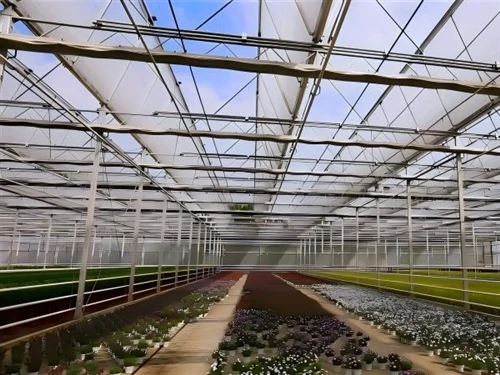
A sound flower greenhouse ventilation plan moves air to remove heat and humidity. Every method below works only if the frame is built to carry it - and the failures we see in the field are rarely in the equipment. They are in the structure underneath.
Ridge vents run along the top of the house; warm air rises through them and pulls cooler air in through the sides. Simple physics - but the frame has to survive it. Every edge of a vent opening carries extra wind load, so vents need bracing and properly sized fasteners, not just a bigger actuator.
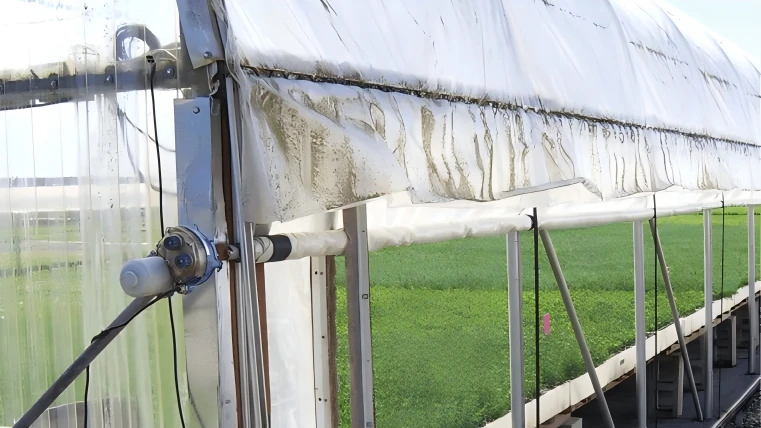
Side roll-up film is the workhorse of low-cost ventilation. A crank or motor rolls the film around a horizontal rod at the side wall. Everything depends on that rod staying straight. Once it sags - even by a few millimeters - the tension goes uneven, the film tears, and within a season you are replacing panels. Space the brackets evenly and size the rod for its span.
End wall doors do two jobs: open, they let wind blow through; closed, they keep the airflow path for the fans. Both put load on the headers above the openings - rolling doors are heavy, sliding doors bind when tracks shift. Check header stiffness and track alignment before the concrete sets, not after the door jams in August.
For hot, dry climates, the greenhouse fan and pad system is the standard answer. Exhaust fans pull air through wet cellulose pads at the opposite end; evaporation drops the air temperature several degrees. Fans run for months; mount them on reinforced members, not light purlins. The pads sit in a zone that stays wet all season - here coating mass decides how long the frame lasts. We hot-dip galvanize our profiles to Z180–Z275; members next to the pads get more.
Shading, Misting, and Irrigation: Loads the Frame Has to Carry
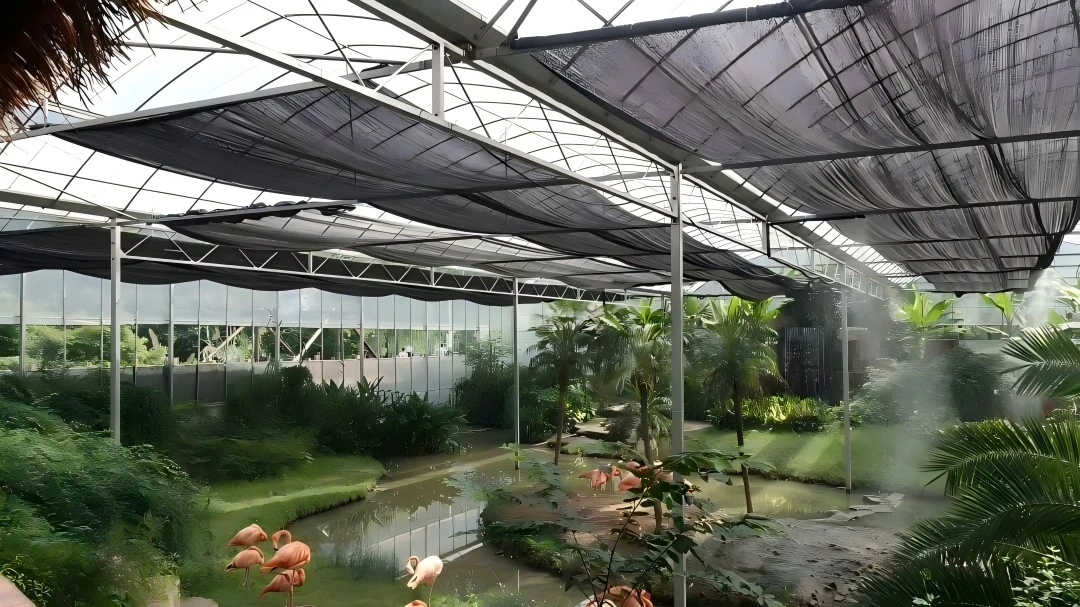
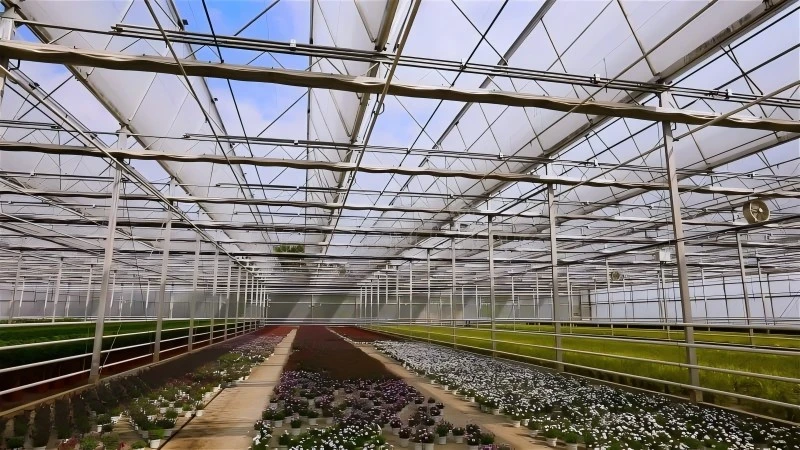
The greenhouse shading system is usually the cheapest thing that actually moves the needle in summer. Shade cloth is sold by the percentage of light it cuts; for flowers, the usable range sits between 30 and 70 percent. Below 30 you might as well skip it, above 70 most crops lose growth.
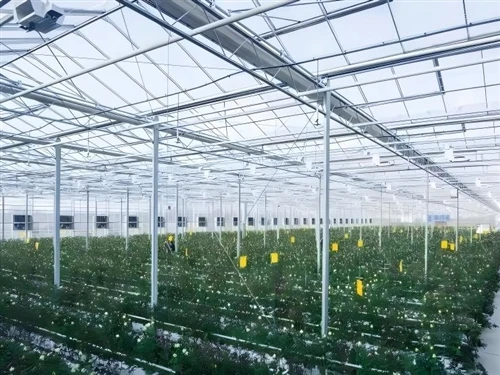
Internal shading hangs under the roof, run on cables or tracks by a motor; it adds dead load across the span - fabric, drive cables, motors, and rails - so mount it to the trusses and let the load go straight down the columns. External shading sits above the roof and stops heat before it enters the house, but wind and UV hit it all year, so supports and fixings must be stronger. Track alignment decides whether this works; crooked tracks bunch the fabric, jam the drive, and shorten the curtain's life.
Mist cooling suits hot, dry air. High-pressure lines under the roof turn water into fog; the evaporation pulls heat out of the air. The lines are light; the pipes, the water inside them, and the supports are not. An irrigation boom adds the same kind of load: rails, a motor, and a boom full of water. When you ask for a frame quote, hand over the equipment list - mist lines, irrigation rails, shade curtains, cable trays. A frame engineered for dead load and snow alone flexes under the combined weight of climate equipment. It will not fall the first year. It will flex, sag, and bind by the third.
The Mistakes We See Most Often
Three mistakes come back to us again and again.
Ventilation area too small. Vents must be sized against the floor area; undersized openings let heat and humidity build up even while the fans run. Enlarging vents after the frame is up is expensive.
Shade net wind load ignored. An external screen behaves like a sail, and the force travels down the cables into the frame; undersized supports tear the anchors out or bend the members. Use wind-load-rated components and secure every fixing.
Roll-up mechanisms that jam - misaligned brackets, a warped rod, debris in the track. When a mechanism jams on a hot afternoon, the film stays closed and the crop pays within hours; inspect the drive line before the hot season.
A Localized Setup for Your Climate
Cooling setups follow the climate, and the frame follows the setup. Across our orders, three patterns stand out.
Southeast Asia: hot and humid. Humidity is the real enemy - stagnant wet air is what gray mold needs. Roof ventilation plus side roll-up film, with external shading above, is the setup we see most: roof vents pull wet air out at the top, the side film opens early, external shading cuts solar load first. For the frame, the point is corrosion: a humid climate works steel harder than anywhere, so coating mass matters more than section size.
Central Asia: hot and dry. Low humidity makes evaporative cooling very effective, so the fan and pad system earns its place here more than anywhere, paired with internal shading that protects the crop without blocking fan airflow. The wet zone around the pads never dries out; we push coating mass up there and check that fittings are compatible with galvanized steel.
East African highlands: strong sun, strong wind, cool nights. The house must shed heat quickly by day and hold it overnight; roof ventilation plus internal shading is the setup we quote most here. The frame's job is wind: highland gusts exceed what lowland designs assume, so we size members and fixings against local wind data.
Quick Reference: Ventilation and Shading by Flower Crop
The table below is a starting point, not a rulebook; latitude and weather move the numbers.
Table 1 - Typical ventilation and shading settings by flower crop
|
Crop |
Light demand |
Typical shading rate |
Ventilation priority |
|
Cut roses |
High |
30–50% in summer |
Strong roof and side ventilation; add fan and pad in hot, humid climates |
|
Gerbera |
Moderate |
40–50% |
Continuous air movement to reduce mildew pressure |
|
Chrysanthemum |
Photoperiod-sensitive |
40–50% thermal shading; blackout cloth for day-length control |
Reliable roof ventilation and precise light management |
|
Phalaenopsis orchid |
Low |
50–70% |
Fan and pad for steady humidity and airflow |
|
Lily |
Moderate |
40–50% |
Roof ventilation plus root-zone cooling |
|
Carnation |
High |
Up to 30% in peak summer |
Maximum airflow; avoid stagnant zones |
The Frame Carries Everything
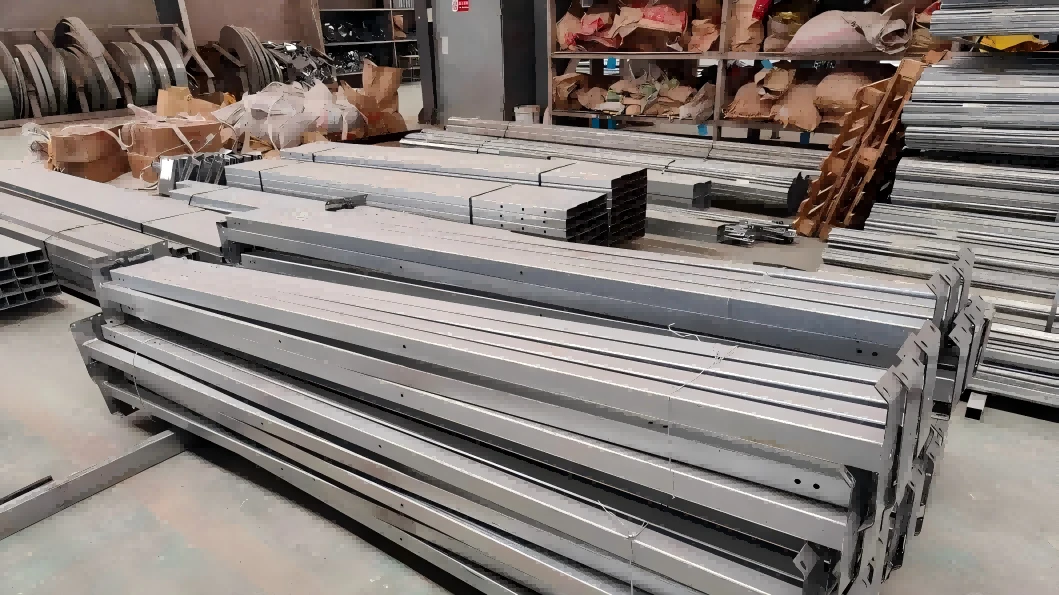
None of these systems stands alone. Ventilators, screens, fans, pads, mist lines - every kilogram ends up on the steel frame. Get the frame right, and the climate equipment keeps working for decades. Get it wrong, and the failure shows up in the hottest week of the year.
One honest note: we are steel suppliers, not ventilation engineers. What we guarantee is that the frame carries every load your climate system puts on it.
Before you order, a few practical points. Specify hot-dip galvanized steel and check the coating mass on the certificate. We are a manufacturer and trader of GI and GL steel coils and greenhouse frame components, and we share the load data for every profile. Send us the house size and equipment list; our engineers check the numbers.