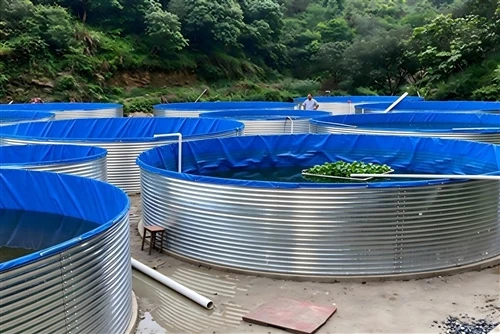
Bolted corrugated steel tanks are one of the steadier lines in our export sales. We do not build tanks ourselves. What we supply runs from hot-dip galvanized coils to formed corrugated panels: some buyers take the coil for their own roll-forming line, others take punched, corrugated sheets ready to bolt into reservoir walls, fire reserve tanks and fish farming ponds abroad. The same questions come up in buyer conversations: which zinc grade stands up to salt air, how thick the sheet should be at each diameter, and what a potable tank needs beyond the steel itself. The notes below cover what we normally ship, and the edge cases that tend to come back after delivery.
Why bolted galvanized tanks keep winning specifications
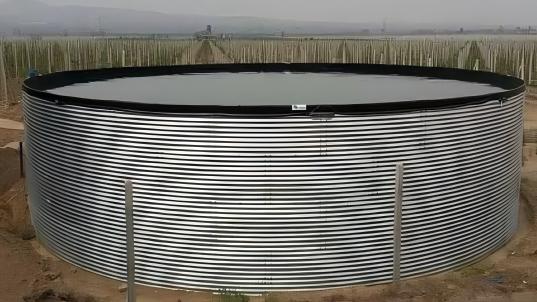
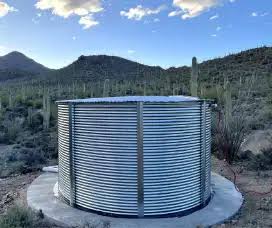
Concrete and plastic still have their place, but for medium-to-large water reservoirs and storage tanks, the bolted corrugated panel wins on practical points. Panels roll into flat bundles and ship at a fraction of a welded or precast unit's volume, which matters for rainwater harvesting schemes and farm reservoirs located inland from the nearest port. Assembly takes place on a compacted pad with hand tools and a bolt torque schedule; no formwork, no curing window. When a farm expands years later, panels can be unbolted, extended with an extra ring, or moved elsewhere.
Service life depends mostly on the outside atmosphere rather than the water inside. A Z275 wall in a dry inland climate, touched up around the splash zone, typically runs past twenty years. Beside the coast or in a chemical district, Z275 loses zinc far faster - the point at which buyers wish they had paid the small difference for Z350 or an aluminium-zinc panel.
Potable water: where the zinc layer stops being enough
This point gets confused most often in early quotations. For irrigation reservoirs, fire reserve tanks and aquaculture, the inner wall stays bare galvanized and works fine where water is neither strongly acid nor alkaline. Potable water changes the rule: drinking-water regulations in most markets do not accept bare zinc as a permanent wetted surface; the approved inner solution is a welded food-grade liner (EPDM or PE film) or a sprayed epoxy coating bonded to the panel. The zinc layer still belongs on the exterior wall; the liner protects the water, and the two should not be swapped on the drawing.
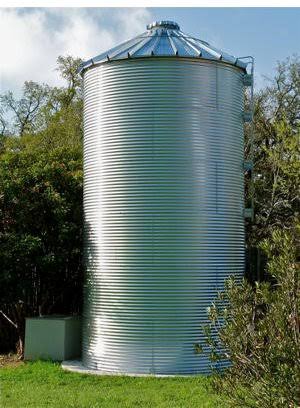
Round corrugated tanks are common fish farming ponds - holding, nursery and grow-out units on small and medium farms. Dense stocking raises ammonia and disinfectant levels, favoring Z350 or a lined wall over a bare Z275 surface.
Before quoting a drinking-water project, get three details from the end user: the local standard (NSF/ANSI 61-type acceptance in North America, or the national equivalent), the approved liner material, and the source-water pH range. Water below pH 6 dissolves zinc faster and weakens the liner bond over time. Our note on galvanized steel and potable water covers the compliance checklist fabricators ask for.
One distinction to keep in the bill of materials: irrigation and firefighting tanks take general-grade gaskets and standard galvanized hardware; potable tanks call for food-grade gaskets and, in many jurisdictions, stainless or coated fasteners on the wetted side.
Matching sheet thickness and coating to tank size
No single gauge fits every tank. The designer works from hydrostatic head - water depth at the lowest course - plus wind and snow loads, and sets gauges course by course. The combinations below are buying references from our shipping records for field-assembled reservoirs and tanks, not a design specification:
|
Capacity |
Sheet gauge we commonly quote |
Coating grade |
Corrugation depth |
|
50–100 m³ |
1.2–1.5 mm |
Z275 |
38 mm |
|
100–300 m³ |
1.5–2.0 mm |
Z275–Z350 |
48 mm |
|
300–800 m³ |
2.0–2.5 mm |
Z350 |
48–68 mm |
|
800–2,000 m³ |
2.5–3.0 mm |
Z350 |
68 mm |
Treat these as inquiry starting points, not a substitute for the structural calculation sealed on the engineer's drawings. Imperial customers often ask for direct equivalents: G90 corresponds to Z275 and G110 to Z350 under North American standards. Naming one grade and shipping another causes inspection delay, so the mill certificate must match the purchase order exactly.
Cone-bottom tanks drain completely and suit sludge-heavy water or fish farming ponds that need full emptying between batches; the cone ring uses heavier gauges than the wall, and support steel should be budgeted separately. Buried tanks face soil moisture rather than open air and need an asphalt or bonded coating over the zinc layer; that grade falls outside our regular range, and we say so up front rather than quote a standard coil for it.
What we ship, and what we do not
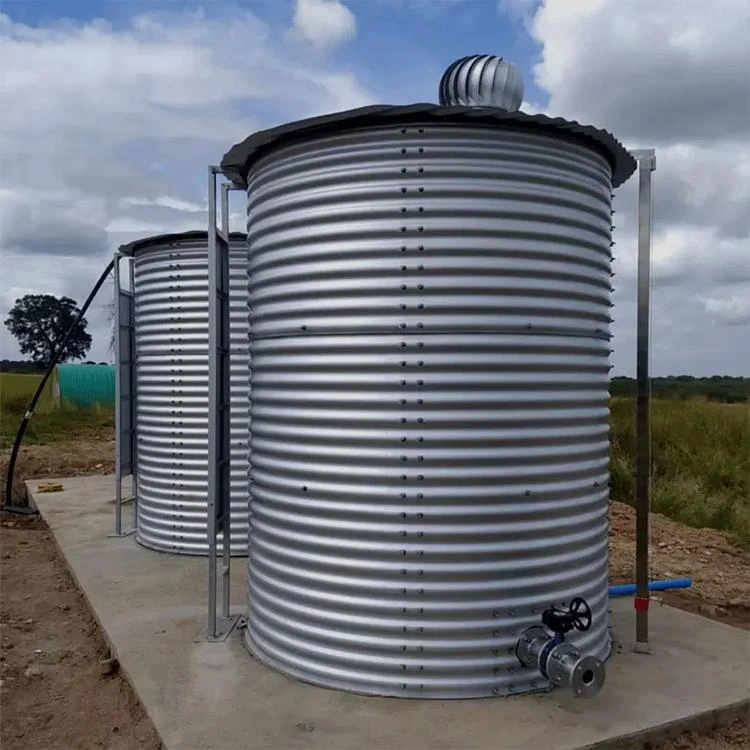
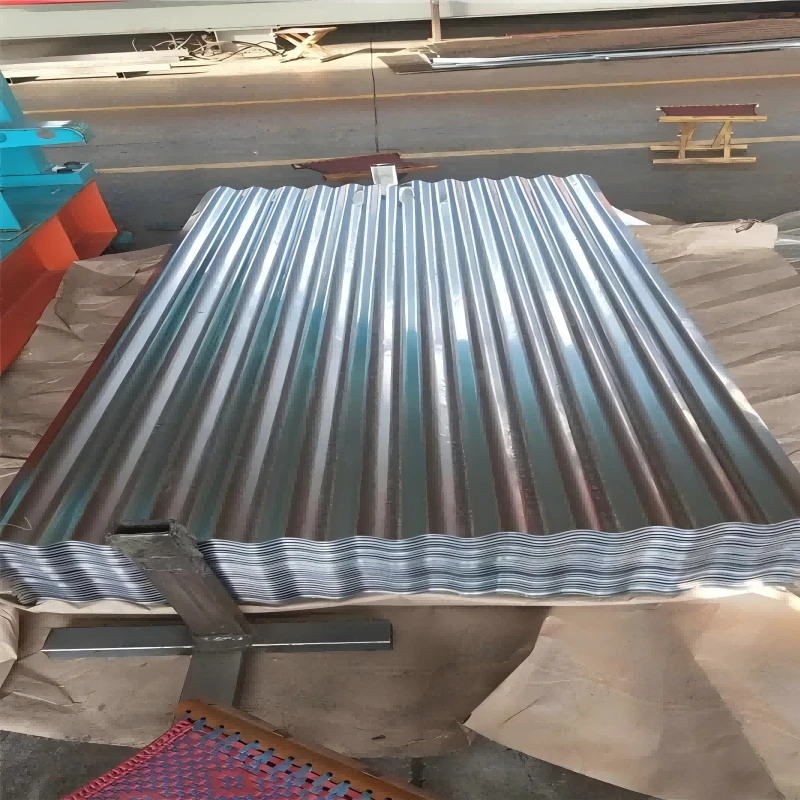
Our shipment scope stays at the material level, in two forms. Buyers with their own roll-forming line take hot-dip galvanized coils and slit strip; buyers without one take formed, punched corrugated panels that arrive ready for bolting. The second option removes one processing stage from the buyer's schedule and shortens the time between order and on-site assembly. A completed tank also needs gaskets, liner film, bolts and nuts, vent caps, manhole covers, outlet fittings, a ladder and the concrete ring. In most markets we serve, these components cost less and clear local regulations more easily through nearby suppliers, so we leave procurement to the fabricator rather than bundling them into our price. State this division in your quotation; disputes usually run one way - the client assumes the sheet supplier also ships the sealed, ready-to-fill tank. For panel sequence, gasket placement and site torque figures, the installation checklist for tank fabricators covers assembly order.
How long the coating holds up, in practice
Zinc protects steel sacrificially: as the exposed layer corrodes slowly, it shields nicks and cuts down to the base metal; grams per square metre decide how long that buffer lasts. Z180 suits only dry, low-pollution inland exposure; Z275 is the ordinary rural and suburban grade; Z350 buys extra margin for coastal and humid sites. Where salt spray or industrial fumes dominate, many fabricators ask about AZ150 aluminium-zinc (Galvalume-type) sheet, which typically outlasts plain zinc at equal thickness there. The galvanized versus galvalume comparison sets out those trade-offs, and the climate-zone coating guide narrows the grade before your technical query.
Maintenance costs little on a cycle. Walk the exterior once a year around the bottom course, overflow outlet and bolt heads; those collect splash water and oxidize first. Spot zinc paint on a fresh scratch takes minutes; waiting until rust blooms across a panel means replacing the sheet.
Questions that come up before the first order
Bare zinc on the wetted side is generally not accepted as a permanent solution under potable codes. Specify an internal liner or epoxy coating; the external wall stays galvanized.
For coil orders we cannot convert volume into tonnage without the panel layout, sheet width, gauge and corrugation profile. If you prefer formed panels, send the same drawing and we quote panel count and weight per sheet.
No. Liners, gaskets and fasteners should be purchased locally to match the local health code and shorten delivery time.
Stock grades in common gauges move quickly; custom profiles and special coating grades follow a mill rolling cycle stated in working days on our offer. Send grade, gauge, tonnage and destination port and we confirm the loading schedule.
If you are quoting a tank project now, gather the panel drawing and site exposure condition before sending the inquiry. The products page lists the coil grades and formed corrugated panels in regular production; the inquiry page takes the drawing, tonnage and target delivery date, and we return mill-certified specifications and a formal quotation. Technical or commercial questions go through the contact page.