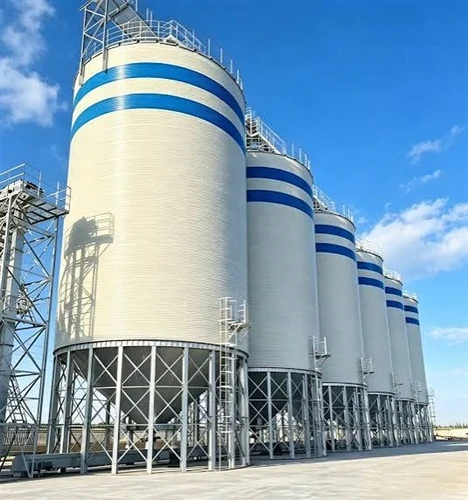
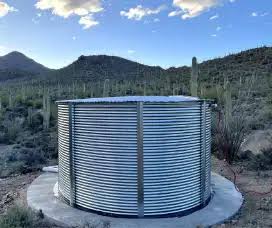
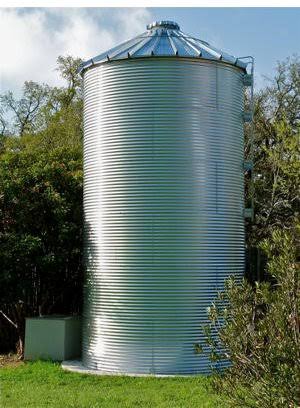
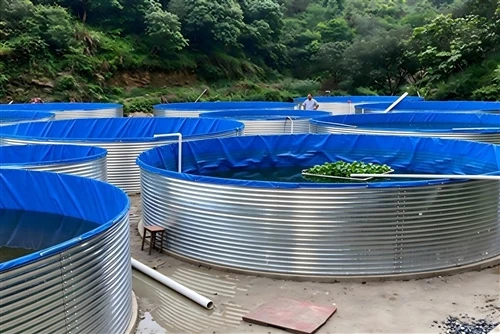
Across irrigation schemes in Southeast Asia, livestock farms in East Africa and municipal backup systems in parts of South America, corrugated galvanized steel reservoirs have become a practical alternative to concrete and plastic tanks. The design combines the structural efficiency of continuous corrugation with the proven corrosion protection of hot-dip zinc coatings, delivering rapid installation and multi-decade service under continuous water contact.
How corrugation handles hydrostatic pressure
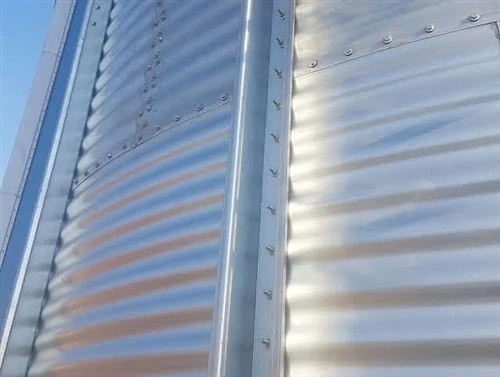
Water pressure increases linearly with depth. Flat steel panels require greater thickness or extensive external stiffening to resist the resulting hoop stress. Continuous 360-degree corrugation raises the section modulus of the plate, increasing hoop strength by approximately 20–35 percent compared with flat panels of the same thickness (engineering references aligned with EN 1993-4-2 and similar design guidance). This allows wall sheets typically ranging from 1.2 mm to 4.0 mm or 6.0 mm to support capacities from 50 m³ to more than 10,000 m³ without internal bracing in many configurations. The same profile improves resistance to buckling under wind or seismic loads, a practical advantage in typhoon-prone and earthquake-active regions.

Performance of zinc under long-term immersion
Hot-dip galvanizing forms a metallurgical bond that provides both barrier and sacrificial protection. In neutral to mildly alkaline water (pH roughly 6.5–9.0), zinc corrodes preferentially and forms stable carbonate and hydroxide films that slow further attack. Industry data referenced to ASTM A123 indicate that coatings meeting or exceeding 3.9 oz/ft² (approximately 1,200 g/m² total in some heavy specifications, or standard Z275–Z600 ranges for lighter panels) commonly deliver 25–40 years of service in temperate and inland conditions. In coastal or high-humidity tropical sites the rate accelerates, yet properly specified galvanizing still outperforms uncoated or thinly painted steel. Many agricultural and municipal installations report 15–30 years of reliable operation with minimal structural intervention when water quality is monitored and liners are used where required.


Modular construction and total cost
Panels are factory-formed, hot-dip galvanized and bolted on site with gasketed joints. A medium-capacity reservoir can be erected in days rather than the weeks or months required for concrete. The structure is relocatable, expandable by adding rings, and fully recyclable. Comparative cost assessments for agricultural irrigation tanks frequently show 20–30 percent savings versus concrete of similar volume once foundation, labour and construction time are included. External zinc protection continues even if the interior is fitted with a potable-water liner, extending shell life while safeguarding water quality.

Practical limits and detailing
Aggressive water (high chloride, low pH or elevated temperature) shortens coating life; in such cases epoxy or polymer liners are added. Roof design, freeboard and overflow details control external wetness and algae. Regular inspection of bolts and gaskets maintains watertightness. When these factors are addressed at the design stage, corrugated galvanized steel reservoirs provide a robust, cost-efficient solution for farms, fire-protection systems and remote water storage across humid tropical and subtropical markets.
For project-specific recommendations on thickness and coating, request a quote.