By 2025–2026, requirements for cable trays in commercial buildings, data centers, and smart factories have moved beyond basic load capacity and corrosion resistance. Specifiers increasingly demand systems that support visual identification, lower ongoing maintenance, reduced glare, and better resistance to everyday handling. Traditional bright galvanized surfaces or smooth powder coatings often show fingerprints, scuffing, and strong reflections in multi-user or frequently accessed environments. Matte textured (matt wrinkle or micro-wrinkle) color-coated galvanized steel addresses these points through a permanent micro-textured surface formed during the coating cure, combining appearance, abrasion tolerance, and practical handling benefits. Market analyses, including those from Data Bridge Market Research, show Asia-Pacific leading cable tray demand with roughly 37 percent global share in recent years, driven by data-center and commercial construction growth that favors integrated finish solutions.


The micro-wrinkle texture develops naturally during high-temperature baking of the topcoat rather than through post-embossing. Raised peaks take contact while recessed areas remain protected, so minor marks and fingerprints remain less visible. Specular gloss, measured by methods such as ASTM D523 at a 60° angle, is typically held between 5 and 15 gloss units-well below levels that produce strong reflections under overhead lighting. This low-gloss character improves visibility and reduces visual fatigue in occupied spaces. Pencil hardness ratings for textured systems commonly reach 2H or higher, supporting better scratch performance than many smooth finishes under comparable coating thicknesses. The same surface also increases friction slightly relative to polished steel, which can help limit minor cable movement under vibration or thermal cycling, though it is not a substitute for proper cleating or bundling.


Corrosion protection and decoration are combined in a single pre-painted product. The galvanized substrate, commonly specified in the Z60–Z180 range under continuous hot-dip standards such as EN 10346 (total zinc mass on both sides), supplies sacrificial protection. Organic topcoats-polyester (PE) for controlled indoor use, silicone-modified polyester (SMP) or high-durability polyester (HDP) where greater weather or UV exposure is expected-add barrier performance and color. Typical base steel thicknesses for tray production run from 0.6 mm to 1.5 mm, allowing roll-forming or press-brake fabrication directly from coil. Color can be matched to the RAL palette, enabling consistent differentiation of power, control, data, or life-safety circuits. Industry practice in data centers and commercial projects increasingly uses such color coding to speed identification and reduce misrouting; this aligns with broader labeling approaches referenced in standards such as TIA-606 series, where visual cues support faster maintenance. Compared with uncoated hot-dip galvanized trays (metallic sheen, limited color options, often preferred for outdoor or aggressive industrial sites) or post-applied powder coatings (flexible color but additional process steps and potential edge coverage variation), the pre-coated matte wrinkle route reduces secondary finishing while retaining cathodic protection at cut edges through the zinc layer.
These characteristics suit visible runs in commercial complexes and office buildings, data centers and weak-current rooms where low reflection and clear route identification matter, industrial facilities that zone circuits by color, and public-building electrical works that balance appearance with durability. In Asia-Pacific markets, where commercial and data-center investment continues to expand, the combination of low maintenance, RAL customization, and forming-ready coil supports both tray manufacturers and project teams seeking fewer on-site touch-ups.
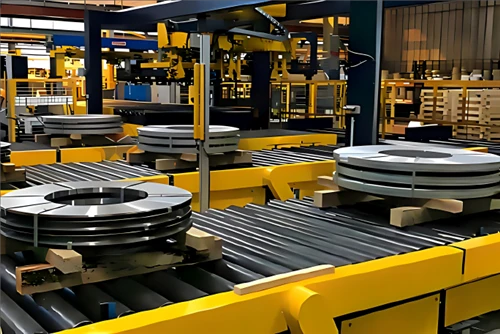
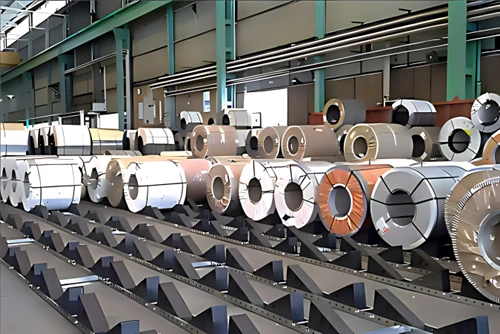
Manufacturers can supply coils with tailored thickness, width, zinc mass, RAL color, and controlled wrinkle intensity so fabricators form finished trays without intermediate painting. Electrical contractors, tray producers, and design institutes evaluating low-gloss, color-coded, low-maintenance systems will find the matte textured color-coated galvanized approach offers a practical balance of function and appearance for contemporary cable management.