The Cable Tray Surface Argument Starts at Commissioning
Most discussions of cable tray finishes start with appearance and finish with price. In our experience they should start at commissioning, because that is the week the decision becomes visible. A contractor walks a hall, looks up at a channel filled with patch cord and power cable, and finds the bundle has crept along an inclined section nobody thought was inclined. Ties go in, the schedule slips by half a day, and the same correction repeats at the next change window. Multiply that across several hundred metres of overhead tray and the finish stops being a surface question and becomes a labour question. It is one of the quieter 2026 data center trends cable tray buyers are pricing into projects: more cable, higher up, handled more often. Cabinets that ran 5 to 15 kW now sit at 100 kW and above in direct-to-chip halls, fibre counts climb with each switch generation, and routing has moved overhead precisely so that it can be changed without lifting a floor tile.
Smooth coil is not a poor product. It is a passive one. A PVC or LSZH jacket on a flat, low-roughness surface has little to resist lateral movement, so the fixing strategy carries the whole job. That arrangement holds while the run stays horizontal and static. It stops holding when the run tilts, when pumps and fans keep the structure under continuous low-amplitude vibration, or when a technician pulls a bundle to re-patch one port and leaves the rest of it shifted.
What a Wrinkle Pattern Actually Changes


A matt wrinkle steel coil cable tray surface is not a decorative option. The pattern is embossed into the organic coating while the coil is still in the line and cured before coiling, so it lives inside the film rather than on top of it. That is why it survives wiping, label adhesive and the inevitable contact with a ladder foot, and why it does not disappear after the first commissioning clean-down. Two properties change. Gloss falls, typically to 5 to 12 units at 60° geometry against 30 to 60 on a smooth polyester, so the tray stops throwing light back at whoever is reading jacket print. Friction rises, because the micro-relief gives the jacket a place to sit instead of a plane to slide across.
On friction we are deliberately careful. We do not publish a coefficient, because the value depends on jacket compound, cable mass, tray inclination and how much dust has collected since the last clean. Remove those conditions and the number describes a laboratory, not a hall. What we will state is where the effect matters: inclined sections, vertical risers, and long overhead spans where only gravity and vibration are acting on the cable. Where a design already clamps cable at short centres, the gain is small and we say so before the quote rather than after it.
Holding a Corrosion Barrier Under the Texture
Texture cannot be bought with corrosion performance, and on our line it is not. The wrinkle film goes over a hot-dip galvanised or zinc-aluminium substrate in the usual sequence: metallic coating to ASTM A653/A653M or EN 10346, conversion layer, primer, topcoat. Data halls generally sit in ISO 12944 category C1 or C2, so Z275 with a 20 to 25 µm polyester or HDP topcoat is normally sufficient. We hold film thickness across the pattern so that the raised nodes are not thin points in the barrier, and we measure gloss and coating mass on every batch. That is the evidence we would ask a supplier for if we were the buyer.
Scratch resistance is a secondary benefit that customers notice a year later. A wrinkled film spreads contact load over raised nodes instead of a flat plane, and pencil hardness to ASTM D3363 usually lands at H or above for the systems we run. Colour matching still works, though deep patterns read a shade darker than the nominal chip, which is why we send a physical panel for approval instead of a screen image.
This is the table we use when a tray maker is weighing a switch of finish. Read the ratings as typical behaviour rather than guaranteed values, and test them against your own sample and the tray maker's published load data.
Table 1. Surface comparison for data hall cable trays
|
Surface type |
Friction |
Cable retention |
Appearance and maintenance |
Typical use |
|
High |
Good; fewer ties needed |
Overhead high-density AI and HPC halls |
||
|
Smooth galvanised |
Low to medium |
Adequate; more fixings |
Brighter; marks show easily |
General industrial and light commercial |
|
Smooth powder-coated |
Medium |
Adequate |
Colour matched; softer film |
Sites with strict colour requirements |
Thickness is a tray decision, not a finish decision. Ladder, solid-bottom and wire-mesh units mostly use 0.6 to 1.5 mm substrate, with the texture on the base plate and, where the drawing asks for it, on the side rails. For a high friction cable tray data center package, check the coil width against the developed blank before the texture is fixed: the pattern follows the coil direction, and blanks cut across the grain show a different lay under grazing light. On a roll-formed line, agree pattern depth with the tooling supplier first, since deep relief can mark the inside radius.
Where We Recommend It, and Where We Do Not
We recommend it for overhead runs above hot aisles, for mixed fibre and power zones where jackets of different compounds share one channel and one tie strategy cannot serve both, and for colo rows that change quarterly, where saved re-dressing time is worth more than the coating premium. Overhead cable tray textured steel earns its place in those layouts because the failure it prevents is cumulative rather than sudden. Seen from the programme side, the saving lands in commissioning hours rather than in material cost, which is why it often loses a line-item comparison and wins a delivery one. Cable retention, in the end, is only half of AI data center cable management; the other half is access, and a bundle that stays where it was dressed keeps its labels facing the technician.
We do not recommend it where the tray is fully enclosed, where cable is clamped at short centres by design, or where the run never leaves the horizontal. In those cases the friction gain is real but small, and paying for it is a preference rather than an engineering decision. Telling customers this costs us some orders. It also means the ones who do order come back with a second one.
What We Need Before We Can Quote
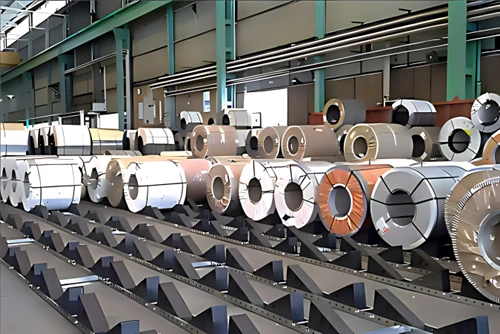
We produce and trade prepainted steel coil. We do not form, weld or load-test trays, and pretending otherwise would be the fastest way to lose a technical account. So the useful conversation is a narrow one. Send the tray drawing or the developed blank width, the jacket compounds in use, the corrosivity category, and whether the line is roll-formed or press-braked. With those four items we can propose thickness, coating system, gloss band and wrinkle depth, and send a sample coil for a trial run on your tooling. Mill certificates and per-batch coating mass and gloss readings travel with the coil. Load ratings, seismic anchorage and thermal calculations stay with the tray manufacturer and the consulting engineer, working to IEC 61537 and NEMA VE 1 as the project requires.
If you are specifying for a 2026 build and the surface question is still open, this is a reasonable point to settle it. Send the drawing. We will answer with a coil specification and the caveats that belong with it.