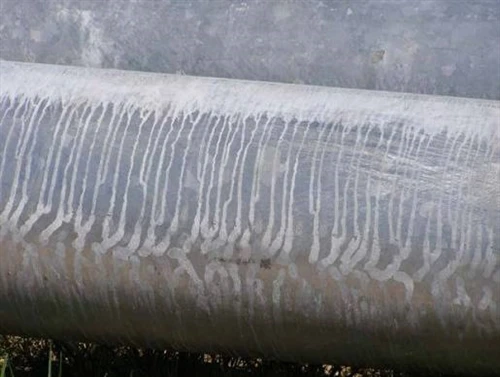
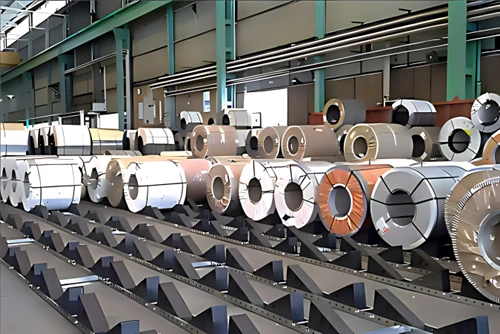
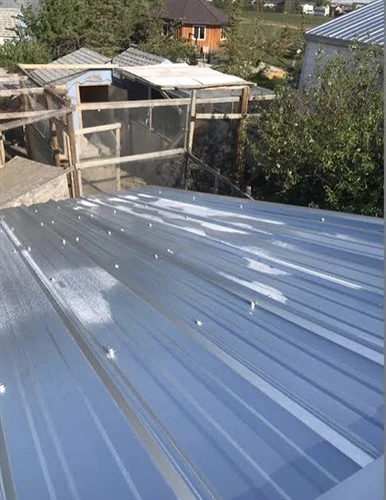
Forming plants and bracket manufacturers often notice that coated coil faces remain clean while slit or sheared edges develop rust spots within weeks of outdoor exposure. This is not a material defect. The continuous hot-dip coating applied to the coil faces is interrupted the moment the sheet is slit or sheared, leaving a narrow band of bare steel that the original coating cannot cover.
How Cutting Interrupts the Coating
In continuous galvanizing or Galvalume lines the metallic coating is applied to both faces of the strip and solidifies before the coil is rewound. Slitting or shearing severs that continuous layer. The cut face exposes the full thickness of the steel substrate, typically 0.4–1.5 mm, bordered only by the thin metallic coating on the top and bottom surfaces. No residual coating remains on the vertical cut itself. Microscopic examination of factory-cut edges confirms an abrupt transition from coated face to bare steel, exactly as described in technical notes from the GalvInfo Center.


Electrochemical Activity at the Exposed Edge
Once moisture and dissolved salts form a thin electrolyte film, the geometry creates a classic galvanic couple. The large area of bare steel acts as the cathode where oxygen is reduced; the small adjacent area of zinc (or zinc-rich phase) acts as the anode and dissolves preferentially. Laboratory mapping with the scanning vibrating electrode technique (SVET) and scanning electrochemical microscopy has repeatedly shown this spatial separation of anodic and cathodic sites within hundreds of microns of the cut. Zinc ions released from the anode can later precipitate as protective corrosion products that slow further oxygen reduction, yet the initial high cathode-to-anode ratio still drives rapid early attack on the steel. Field exposures at marine sites confirm the same sequence: red rust appears first at the cut, while the coated face remains intact.


Why the Edge Advances Faster Than the Face
The face is protected by an intact metallic barrier plus any organic topcoat. At the edge the barrier is absent and the available sacrificial metal is limited to the coating thickness immediately adjacent to the cut (roughly 7–20 µm of zinc on each side for typical G90 or AZ50 material). Moisture also lingers longer in the narrow edge geometry and at laps, raising the local time of wetness. Five-year atmospheric exposure data published in Progress in Organic Coatings showed that paint delamination and red-rust extent both increased with steel thickness and decreased with zinc coating weight, precisely because thicker steel presents a larger cathode for the same amount of nearby zinc. In humid, high-chloride environments classified as ISO 9223 C4–C5 (coastal Florida, UK maritime zones, and similar locations), this difference becomes visible within months rather than years.


Differences by Coating Type in the Early Stage
Pure-zinc galvanized coatings supply a continuous sacrificial anode and therefore tend to delay the first visible red rust at thin edges. Galvalume (55 % Al–Zn) relies more on the aluminum-rich barrier; its zinc-rich phases still provide some galvanic protection, yet early edge staining is more common, especially where water is trapped. Industry observations summarized in Metal Construction News note that this early staining is normal and usually stabilizes once zinc corrosion products form. In both cases the face coating continues to perform according to its design life; only the cut edge shows the accelerated initial response.
| Location | Coating status | Corrosion risk | Typical appearance |
|---|---|---|---|
| Coil face | Intact metallic + paint | Low | Remains clean for extended periods |
| Sheared edge | No coating protection | High | Rust spots appear relatively early |
| Overlap / lap | Possible gap | Medium–high | Depends on sealing and drainage |
Implications for Forming and Bracket Work
Understanding the mechanism lets roll-formers, solar-mounting fabricators, and agricultural-structure shops set realistic expectations and choose appropriate edge practices. Thin-gauge slit coil used for purlins or brackets will show cosmetic edge rust in outdoor service long before the faces are affected; this does not indicate insufficient coating weight on the faces. Design details that promote drainage, avoid trapped water at ends, and keep dissimilar metals away from the edge reduce the practical impact. Where long-term edge appearance is critical, higher zinc or aluminum-zinc coating weights, or post-fabrication edge treatments, can be considered after the basic electrochemical behavior is recognized.
For further technical discussion of edge behavior, coating selection, and processing recommendations, visit the technical resources section at sino-galvanized.com/info/. Product specifications and performance data for Galvalume coil are available on the Galvalume steel coil page. Contact us for project-specific advice on edge protection and coating choices.