RoHS does not restrict Galvalume coil. It restricts hexavalent chromium at 0.1% in a homogeneous material, and the passivation layer counts as a material of its own. If your coil is treated with chromate, your compliance team inherits a question that the mill certificate cannot answer. If the surface is chromium-free, that question never arises.
What follows is the document set we normally send for home appliance programs and EU-bound orders, the points where chromated coil slows the review, and the wording we recommend for the purchase order.
The coating is not the issue. The film on top of it is

Galvalume is a 55% aluminium, 43.4% zinc, 1.6% silicon coating, specified in ASTM A792 and EN 10346. Appliance frames, back panels, and brackets use it because the coating resists corrosion at a lower cost than a heavier zinc layer. Neither the steel nor the coating carries chromium.
Passivation does. The layer goes on after coating to stop white rust in transit and in storage, and it is where chromium can enter the product. We supply three routes: chromate passivation, trivalent chromium passivation, and chromium-free passivation, the last usually titanium or zirconium based and sometimes covered by a thin organic film. The first can contain hexavalent chromium. The second contains chromium, not in the hexavalent form. The third contains none.
That distinction decides the paperwork. Your customer's questionnaire asks one question about chromium. The answer depends on which of the three sits on the coil.
What RoHS and REACH actually require
RoHS restricts hexavalent chromium to 0.1% by weight in homogeneous materials. The entry is Annex II, item 9, of Directive 2011/65/EU, as amended by (EU) 2015/863. The Directive covers electrical and electronic equipment, so it does not apply to a coil of steel. Your appliance OEM carries it for the finished unit and pushes the evidence requirement down to the supplier. That is why the coil order arrives with a declaration attached.
The test is per homogeneous material, not per product. A passivation film weighs a few grams per square metre and is assessed on its own. This is the detail that gets missed: the film is thin, but it is not exempt because it is thin.
REACH (Regulation (EC) No 1907/2006) works through different routes. Article 33 requires information on a substance of very high concern to be passed up the chain when it exceeds 0.1% by weight in an article, and the candidate list behind that duty changes twice a year, usually in January and June. Annex XVII restricts named substances and uses. Chromium trioxide also sits on Annex XIV, the authorisation list.
Note what these two regulations do not do. Neither tells you which passivation to buy. They tell you what you have to be able to show, to whom, and at what concentration.
The six documents we normally send
The names change with each customer. The content does not.
Substance declaration. Built on your customer's form, often keyed to the declarable substance list in IEC 62474. It should treat the metallic coating, the passivation film, and the substrate as separate items, because your auditor will.
Test report. From an accredited laboratory, using IEC 62321-7-1 for hexavalent chromium in corrosion-protective coatings on metals. The boiling water extraction is the part reviewers look for. A report needs the method, the sample identity, the detection limit, and the result with its unit. A screenshot of a number does not pass.
Supplier declaration of conformity. One page supporting the appliance's EU Declaration of Conformity. It names the product, the standard, and the restricted substance status.
Inspection certificate to EN 10204 3.1. Grade, coating mass, heat number. For appliance work this is usually AZ150, or 150 g/m² across both surfaces.
SVHC statement. Dated, with the candidate list version it refers to, and a line stating whether anything listed exceeds 0.1% in the article.
Treatment description. A short summary of the passivation chemistry, or the relevant section of the supplier's safety data sheet, for buyers who handle the coil before assembly.
Where files break is rarely the chemistry. It is the matching. We have seen a heat number on a test report that belonged to a different coil than the certificate, a grade written DX51D+AZ on the declaration and SGCC on the drawing, and a candidate list date older than the last ECHA update. Each one costs about a week.
Where chromated coil adds work
If the film contains hexavalent chromium, the declaration cannot be closed with "not present". You need the concentration in the film and a comparison against 0.1% in the homogeneous material. Coating tests usually report a surface load in µg/dm², so someone has to convert it to a weight percentage. The laboratory report rarely carries that calculation, and the auditor asks for it anyway. We prepare the conversion for customers who need it, with the film weight and the method stated.
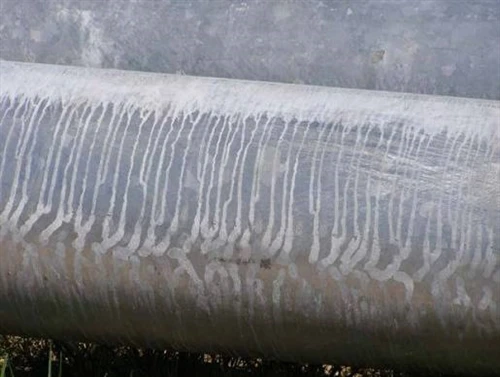
The second problem is the data sheet. Many suppliers write "chromate" without naming the oxidation state. A trivalent chromium film is not hexavalent, but the buyer cannot tell from that one word. The question goes back to the coater and the answer arrives after the audit date.
If your customer accepts no hexavalent chromium at any concentration, none of this matters. The specification changes, and that is the cheaper outcome.
What chromium-free changes, and what it does not
It changes the declaration. Instead of explaining a presence, you state an absence, and the test report supports it. The SVHC statement loses its chromium line. The review is shorter because there is less to argue about.
It does not remove the test. Absence still has to be demonstrated, by the same method, on the same film.
Two details matter before you write the order. The first is language. "Cr(VI)-free" and "chromium-free" are different claims, and a trivalent chromium treatment satisfies only the first. Use one phrase in the purchase order, the drawing, and the declaration request.
The second is performance. Chromium-free systems work through a different chemistry, and the protection you get depends on coating mass, film weight, and how the coil is stored. In humid or coastal storage, a chromium-free surface can show white rust earlier than a chromated one if the packaging traps moisture. We usually advise desiccant where containers sweat, and a transit time that matches the protection you specified. That is a packaging conversation, not a reason to avoid the product. Our own default for European appliance orders is chromium-free, simply because the file is easier to defend two years later, when the people who signed it have moved on.
Table 1. Documentation position of chromated and chromium-free Galvalume coil
|
Document |
Chromated (Cr(VI)) coil |
Chromium-free coil |
What the reviewer checks |
|
RoHS substance declaration |
Quantification in the film, plus conversion from a surface result to a weight percentage |
Statement of absence, supported by the test report |
Cr(VI) content per homogeneous material |
|
SVHC statement |
Chromium entry, and the product must match the list version |
No chromium entry |
Candidate list date and the 0.1% threshold per article |
|
Third-party test report |
Result measured against the threshold |
Absence confirmed by the same method |
Method, detection limit, unit, sample identity |
|
Supplier declaration of conformity |
Extra note on the passivation chemistry |
Standard wording |
Consistency with the purchase order |
|
Inspection certificate, EN 10204 3.1 |
Same requirement |
Same requirement |
Grade, coating mass, heat number |
How to specify it so the file passes first time
Three habits do most of the work. Name the passivation type in the purchase order rather than leaving it to the mill's default. Keep grade, coating mass, and heat number identical across the certificate, the declaration, and the test report. Quote the candidate list version on every SVHC statement, and refresh it after each update.
We produce and supply Galvalume in AZ150 and heavier coating masses, with chromium-free passivation available as a standard option for appliance programs and EU-bound orders. We test to IEC 62321-7-1 at accredited laboratories, issue EN 10204 3.1 documents with each shipment, and review your declaration template before the first order rather than after it.
The document set for appliance customers is listed on our Home Appliance Solutions page. If you already have a declaration form, send it to our technical team with the coating mass you need. Checking a template at quotation stage takes a day. Reopening a rejected file after the container has sailed takes rather longer.
Standards referenced: Directive 2011/65/EU and (EU) 2015/863; Regulation (EC) No 1907/2006; ASTM A792; EN 10346; IEC 62321-7-1; IEC 62474; EN 10204.