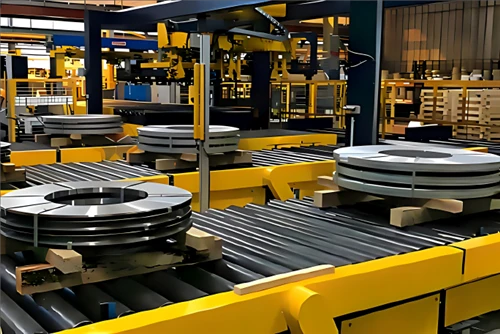
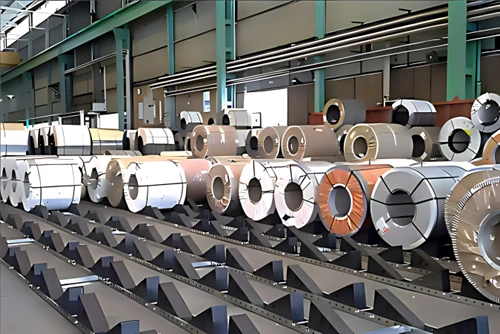
Appliance makers across major production regions have steadily moved away from buying bare or simply galvanized sheet and spraying it after forming. Pre-painted galvanized steel (PPGI) arrives with a finished decorative and protective surface already applied in continuous coil-coating lines. It can go straight to blanking, stamping and bending. The change cuts out entire painting stages, shortens cycle times and reduces the risk of batch-to-batch colour variation that often appears when finish coats are applied in-house. Market analyses place the home-appliance segment as a major end-use for PPGI coils; one 2025 estimate put its share near 20 percent of global PPGI revenue, with Asia-Pacific (especially China, South Korea and India) accounting for the largest share of both coil supply and white-goods output.
The most immediate operational gain is the ready-to-use surface. Because the organic coating is cured on the flat coil under controlled conditions, formers do not need to clean, pretreat or spray panels after pressing. Studies published by the National Coil Coating Association, comparing pre-painted versus post-painted parts exposed in the same coastal environment, have repeatedly shown more uniform film thickness and better long-term corrosion resistance for the coil-coated material. The continuous process also allows tighter control of dry-film thickness (typically 15–25 µm topcoat for appliance grades) and gloss, which is difficult to match with spray methods on three-dimensional parts.


Formability is equally important. Appliance panels frequently require deep draws and tight bends. Grades DX52D and DX53D, specified under EN 10346:2015, are the usual choices. DX52D offers a minimum elongation of 26 percent (A80) and yield strength in the 140–300 MPa range; DX53D raises the elongation minimum to 30 percent while keeping tensile strength between 270–380 MPa. These values, measured on the zinc-coated substrate, allow the organic coating to stretch without cracking when the right primer and topcoat systems are used. Typical sheet thickness for outer panels falls between 0.35 mm and 0.55 mm, balancing weight, rigidity and draw depth.
Corrosion and chemical resistance come from the dual barrier of zinc plus the organic layer. For indoor and kitchen/bath environments, zinc coating masses of Z60 to Z100 (60–100 g/m² total on both sides) are common. The zinc provides sacrificial protection at cut edges and scratches, while polyester (PE) topcoats resist household cleaners, detergents and condensate. Industry guidance notes that PE systems routinely pass 500–800 hours of neutral salt-spray testing at standard dry-film thicknesses, which is adequate for the service conditions of refrigerators, washers and indoor air-conditioner cabinets. Outdoor condenser units may require higher zinc weights or aluminium-zinc substrates, but the same coil-coating route still applies.


Surface consistency and ease of cleaning further support the shift. Continuous coating produces uniform colour and gloss across large runs; matte or anti-fingerprint variants are available without changing the forming process. Because the finish is already cured, plants avoid the capital cost of spray booths, curing ovens and associated emission controls, and they reduce the chance of colour mismatch between doors, side panels and cabinets.
When compared with alternatives, PPGI occupies a practical middle ground. Ordinary galvanized sheet that is painted after forming shows lower surface uniformity and requires extra process steps. Stainless steel offers excellent corrosion resistance but at higher material cost and with different forming behaviour. Plastics are lighter for internal parts yet lack the rigidity and metallic feel demanded by outer panels. Consequently, refrigerator doors and side panels, washing-machine front and top covers, air-conditioner indoor and outdoor housings, microwave and oven casings, and water-heater outer shells are now routinely specified in appliance-grade PPGI.
Producers can supply coils matched to these requirements-custom thickness, width, colour, gloss level and anti-fingerprint treatment-under recognised standards such as EN 10346 for the substrate and relevant coil-coating specifications for the paint system. For OEMs, panel fabricators and purchasing teams seeking shorter lead times, stable colour and reduced in-plant finishing, pre-painted galvanized steel combines ready-to-form convenience with proven forming and protective performance. Contact us or request a quote for appliance-grade specifications.